v1.5.0 — Vendor Launch
The biggest update since v1.4.1. A whole vendor world replaces the old passive contract list — 63 clients across 7 sectors and 3 classes, each with their own reputation ladder and their own bonuses to hand out. Cognitive Overload gets reworked into a hands-on gauntlet. Pretrain configuration deepens. Rarer model tiers open up. And the Black Market gets a Flash Deals refresh.
The biggest update since v1.4.1 is live. The headline is the vendor system — a full replacement for the old passive contract list, with 63 clients, 7 sectors, 3 classes, and a reputation ladder for each vendor you meet. Alongside it lands a reworked Cognitive Overload, a deeper pretrain configuration, rarer model tiers, and a Black Market with sharper teeth. Plus the usual sweep of polish and fixes.
If you’ve been playing since launch, this is the update that finally makes selling brains feel like a relationship rather than a slot machine.
🏢 The main event: Vendors & Contracts
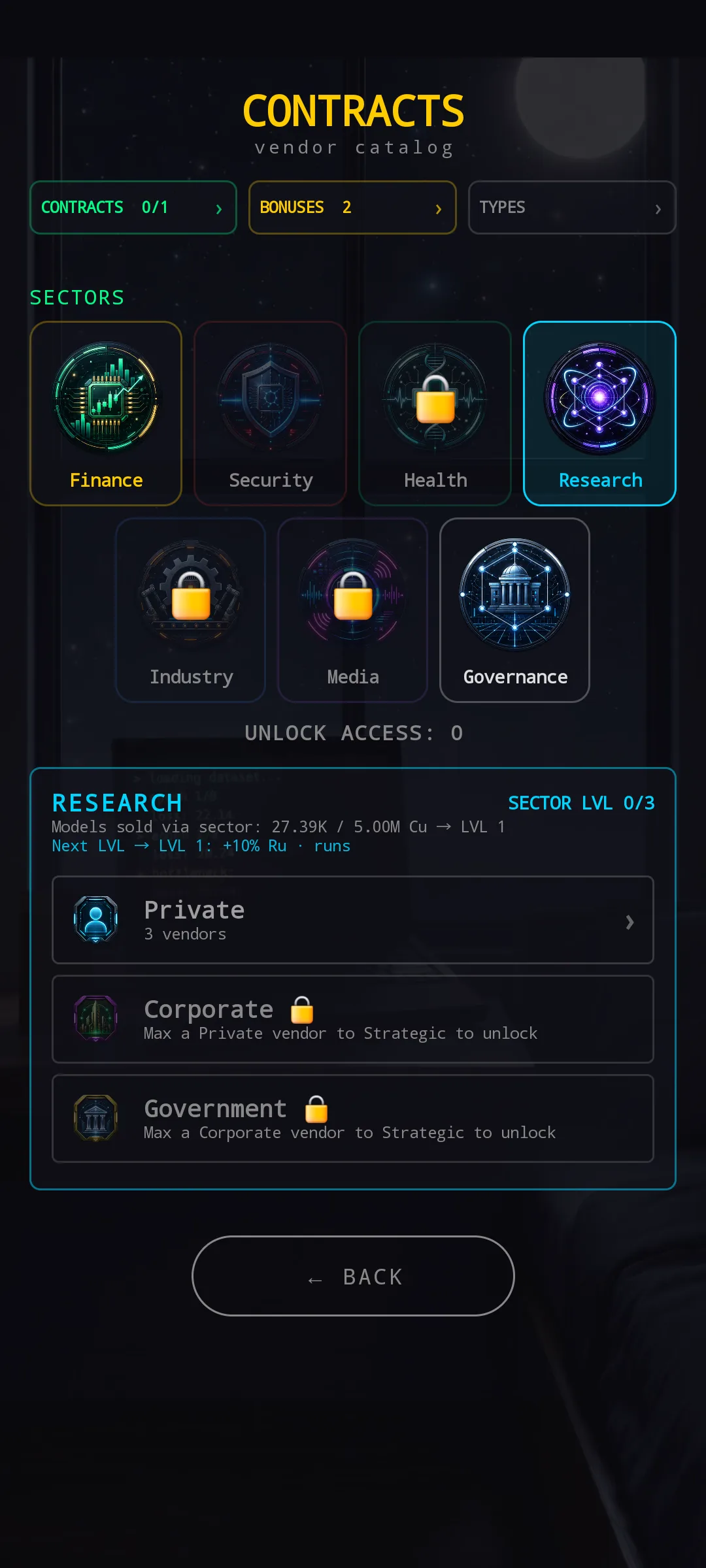
The old contract board was a list. You looked, you picked, you sold. It worked, but it didn’t remember who you were selling to.
The new system is a vendor world. There are 63 clients across 7 sectors (Finance, Security, Health, Research, Industry, Media, Governance), each grouped into 3 classes (Private, Corporate, Government). Every vendor has their own reputation ladder — five steps from Unproven to Listed, Preferred, Trusted, and Strategic. Deliver on their contracts and you climb it. Ignore them or dump on the Black Market instead and you slide back to neutral (never below — no dread).
Each sector rewards you differently. Finance grows your permanent bonus. Health softens Frustration and Fatigue. Industry discounts hardware. Media discounts corpora. Governance opens contract-board slots. Research boosts Ru income. Security stays locked for now — its bonuses are still in design and will land in a future update. Sector bonuses climb with your reputation across the whole sector, not just one vendor.
Every vendor also carries their own contribution on top of the sector-wide bonus. Some pay a Cu bump on their own contracts. Some soften your brain’s Fatigue on the next run. Some open access to rare model tiers. A few — the Meridian Holdings subsidiaries — even amplify each other: build reputation with one Meridian company and the others get quietly stronger.
Government-class contracts are the endgame. They ask for the biggest models and the highest quality — and pay accordingly. To unlock them with a given vendor, you have to max out your reputation with their Corporate counterpart first. To unlock Corporate, you max their Private. It’s a ladder, and every rung matters.
Special contracts show up rarely, ask for something unusual, and pay a premium. See Overload below for the connection.
And yes — contract sales now count toward the global leaderboard, alongside Black Market sales.
Full guide: Contracts & Vendors. Full 63-vendor codex with lore: Vendor Catalog — each vendor’s page is linked directly from their in-game detail screen via the LORE ↗ button.
🧠 Cognitive Overload — reworked
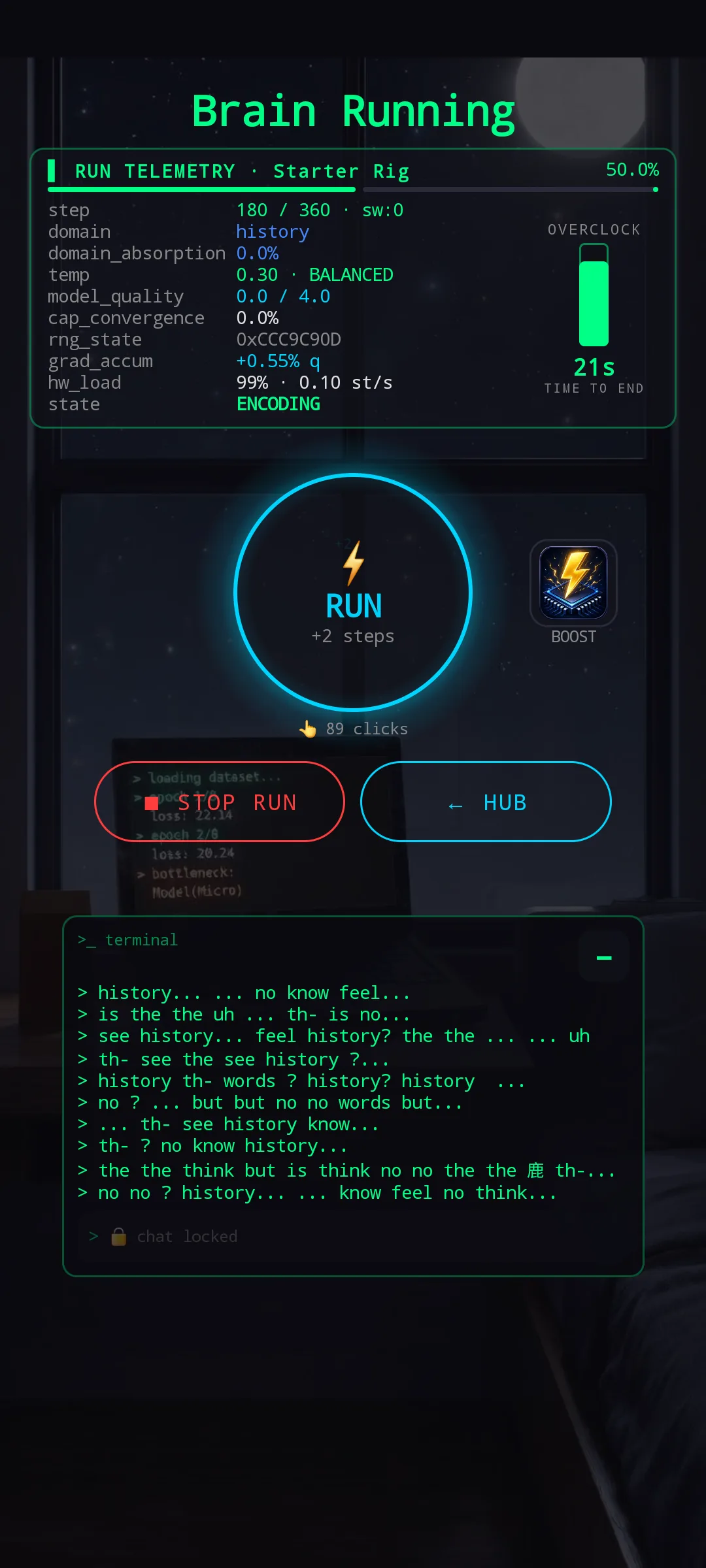
Overload used to be an interesting side option. It’s now a gauntlet, and it works the way its name always suggested.
The rules changed:
- Overload runs are pure manual clicking. No idle progress — the run only moves when you push it. Active, risky, fast when you’re paying attention, and dead in the water when you aren’t.
- The run must run in the foreground. Background the app and it stops advancing. An overloaded brain wants your eyes on it.
- Overload runs are capped at one hour. Long enough to matter, short enough not to trap you.
- Real crash risk. An overloaded system is genuinely unstable, and mid-run failure is on the table.
- Overload is the trial by fire for special contracts. Deliver an overloaded brain that meets a special contract’s requirements and the premium payout is meaningful.
Practical guardrails: when you try to install a module beyond what your RAM comfortably supports, the game warns you upfront. And during an active run you can’t buy more modules — configure the brain first, launch second.
⚙️ Deeper pretrain configuration
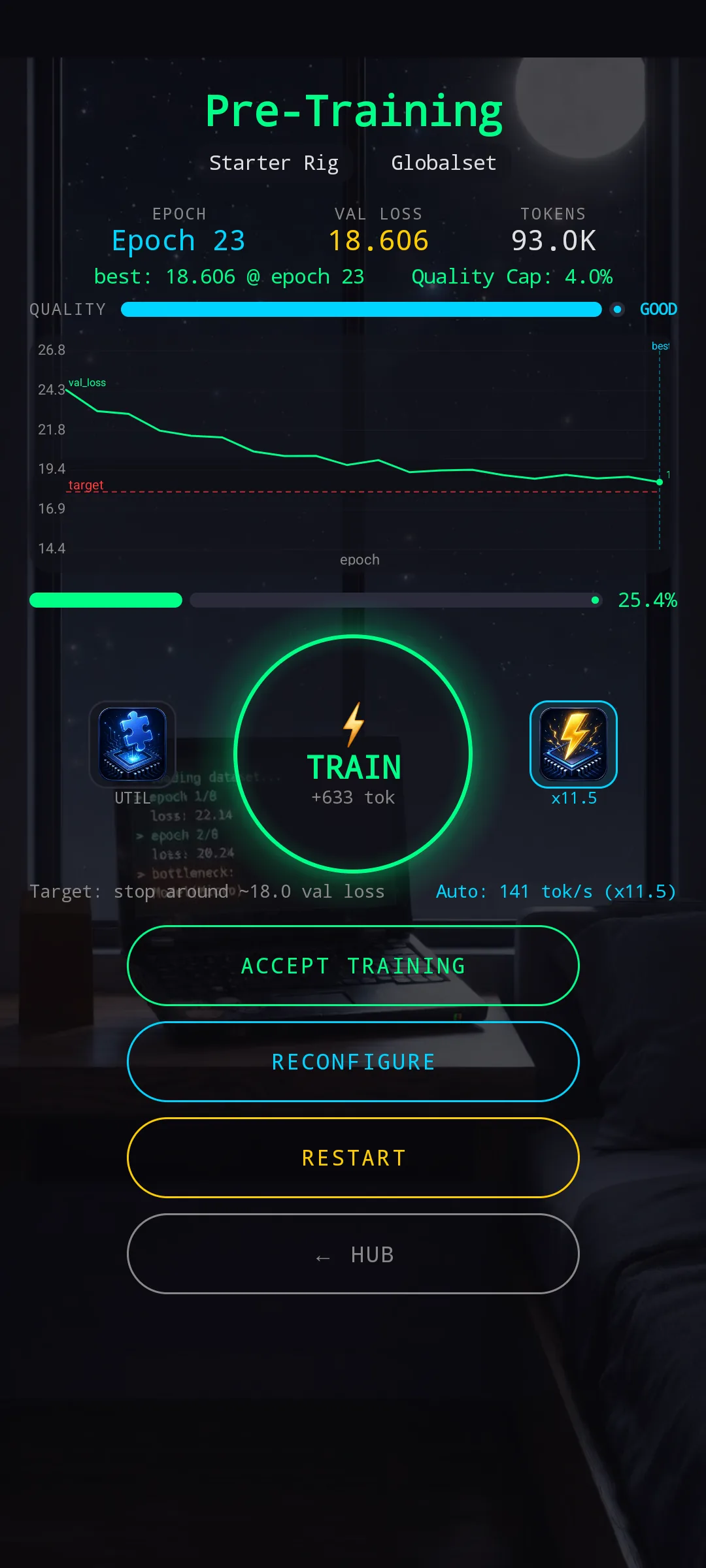
Batch size and sequence length now shape both quality and Ru income.
Before, the levers were narrower — you tuned pretrain and mostly optimized for speed. Now the same knobs also nudge the finished brain’s quality ceiling and how much Ru it earns during runs. There’s more real decision space when you sit down to configure a pretrain, and more room to specialize a brain for what you know a specific vendor is going to want.
We aren’t publishing the exact relationship — this is the kind of thing that’s more fun to feel than to read about. Try a run with a wider batch. Try one with a longer sequence. Compare what the run reports back.
💎 Rarer model tiers open up
New rarity tiers now sit above the standard Baseline:
- Refined
- Distilled
- Emergent
These aren’t guaranteed — they’re something you build toward. Reputation with the right vendors can open the paths that lead there. Which vendors? That one you’ll have to figure out. 😉
🕶️ Black Market — Flash Deals refresh
- Flash Deals reworked. Better feel, and the offers respond to where you stand with your vendors.
- Industry-sector reputation now discounts Black Market hardware on top of the standard shop discount. Since Black Market inventory rotates constantly, this is a discount you’ll actually use.
✨ Polish & quality of life
- Cleaner contract board. Panels are separated and easier to read at a glance.
- “Active contract” is clickable — tap and it jumps straight to the contract in question.
- Cleaner crash flow. A crashed run now points you cleanly at the Black Market for the sale, rather than leaving you to figure it out.
- Clearer reward previews. You see the net amount (after fees) instead of the gross — no surprises at the sale confirmation.
- Small display and label fixes throughout.
🔧 Fixes
- Achievements fixed. A series of contract-sale achievements weren’t firing under some conditions. They fire now.
- Rare run-progress edge cases fixed — the ones where a run could lose its state or miscount its progress.
- Economy pass — assorted rebalancing and stability across the loop.
- Abort labeling clearer. Aborting a run now clearly says “no reward” — the old label was, in Karel’s words, “misleading in three different ways at once.”
Whichever direction you were building before this update, there’s a vendor for it — and a reason to start choosing which sector to commit to first. Have fun with the ladder.
— NeuroVault Research Systems