v1.6.5 — Runs Drop Loot Now (and It Compiles)
A big one. What started as an economy pass turned into a whole new gameplay layer — runs drop source-code fragments and research notes, a crafting chain turns them into a library of 55 unique software programs, and perk slots let you install those programs onto your models to boost sale value. Plus a proper economy rebalance, one-tap contract delivery, a fragment merge mechanic, a retrain lockdown, and a stack of quality-of-life fixes underneath.
v1.6.5 is a big one. What started as a tune-up to the economy turned into an entirely new gameplay layer: loot from runs → software from loot → value from software. Runs drop fragments and research notes, a crafting chain turns them into a library of 55 unique software programs, perk slots let you install those programs onto your models to boost their sale value, and the economy caught a proper pass on top. Plus a fragment merge mechanic, one-tap contract delivery, retrain lockdown, and a stack of QoL fixes underneath.
💾 Runs drop loot now
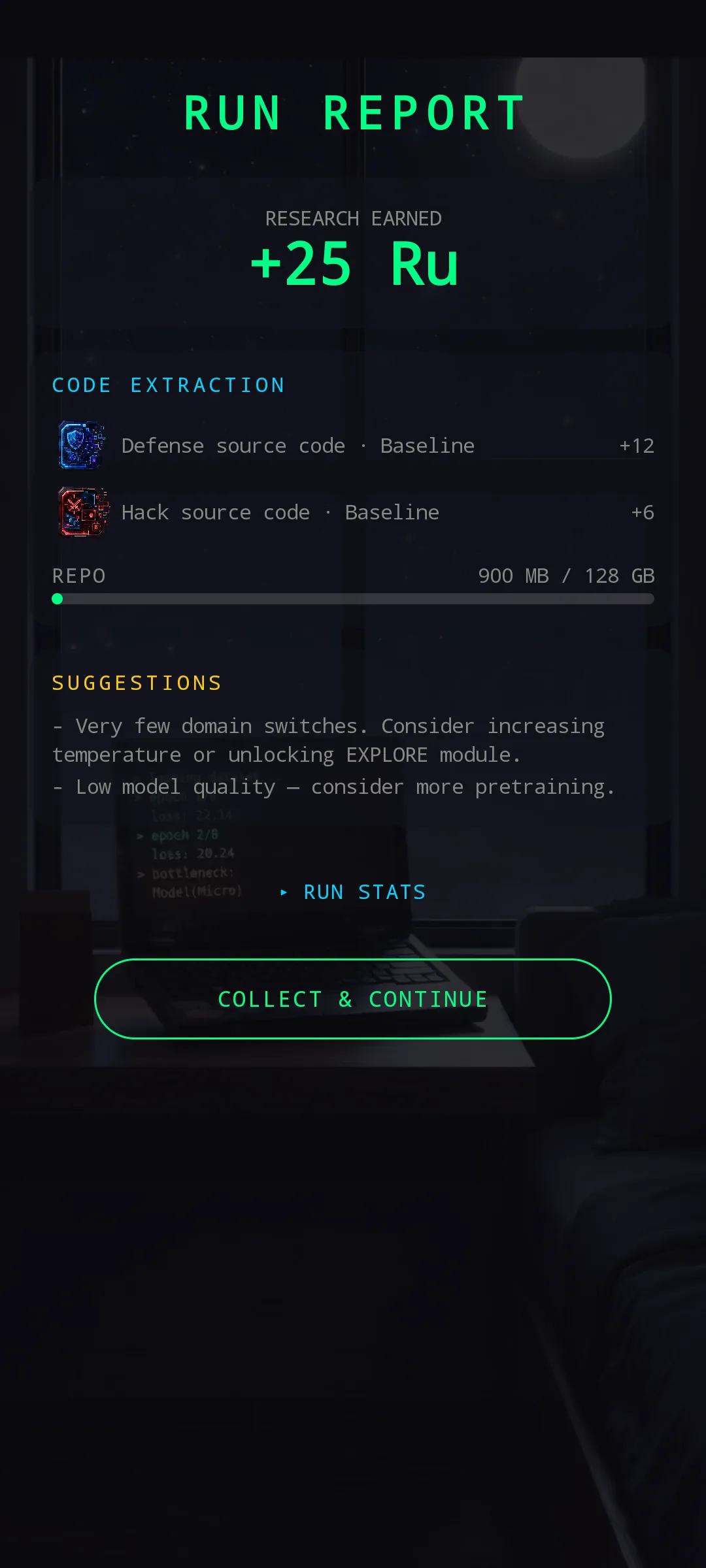
Runs used to be passive — you’d collect Ru, occasionally level a module, and move on. Now runs drop loot and pull the whole game with them.
- Source-code fragments in two flavours — Defense 🛡️ and Hack ⚔️ — drop mid-run. The terminal announces each extraction in real time, the model reacts to it in-character, and the fragment lands in your inventory.
- Research Notes 📚 drop based on the corpora your model is training on — every corpus its own note type.
- Everything lands in the Repo — a new grid inventory inside Neuron Archiv, with filters for Code / Research / Software. Tap a tile to open the detail card and its available actions.
- Shared HDD storage — loot occupies disk space alongside your archived models, so “archive it or free the slot” becomes a real decision.
Loot runs from your first run — the tutorial guarantees your first extraction — so there’s a reason to launch “one more run” immediately.
🧬 The crafting chain — from fragment to software
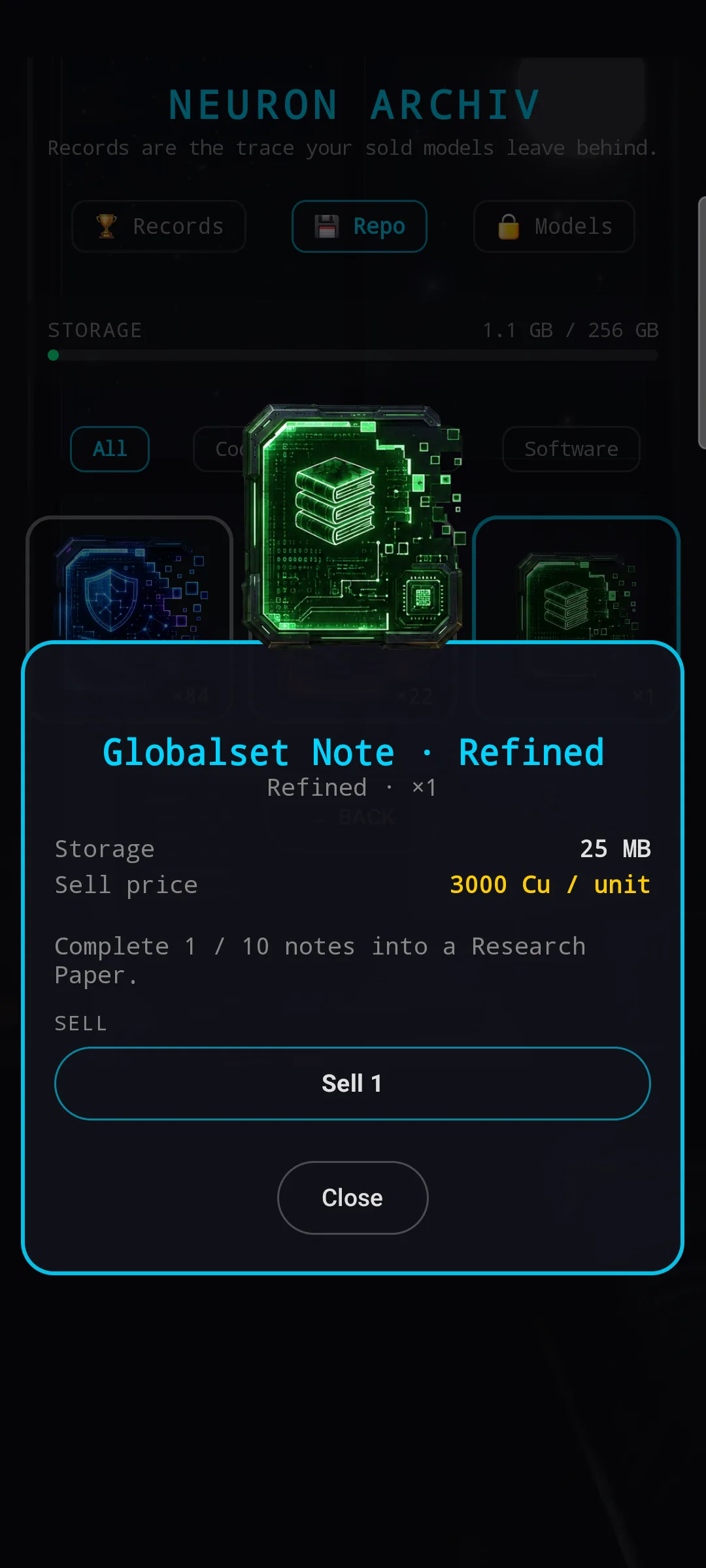
Loot isn’t just for selling. It has depth.
Research Notes → Complete (10 matching) → Research Paper → Analyze → SW blueprint
→ Compile (in a model's perk slot, spending code fragments) → finished Software- Complete — 10 matching notes assemble into a Research Paper.
- Analyze — a paper is decoded into an SW blueprint. Here’s the twist: even a baseline paper has a shot at rolling a rarer software than itself. There’s always an upgrade lottery hiding in the analysis roll.
- Compile — a blueprint compiles into finished software inside a perk slot on a specific model. Compilation runs autonomously during runs (so a run is now doing triple duty: Ru + loot + compile) and consumes matching code fragments. Fragments finally have a use beyond the sell button.
- 55 unique programs to discover — antiviruses, firewalls, DDoS kits, keyloggers, ransomware, and the rest — each with its own name and identity. Build the library.
🎰 Merge — turn surplus into rarity
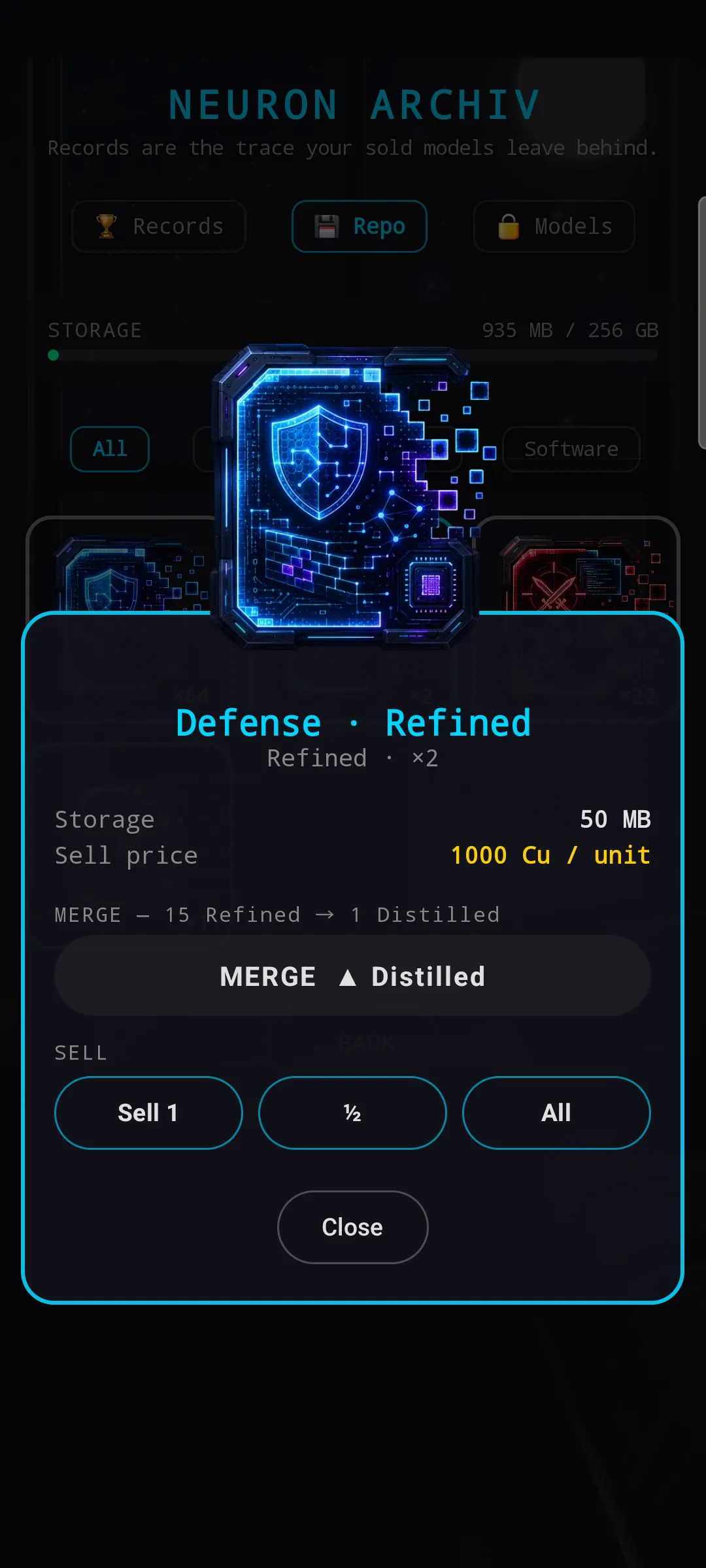
Baseline fragments pile up fast. Rare ones don’t. You can now merge fragments upward:
- 10 baseline → 1 refined
- 15 refined → 1 distilled
- 20 distilled → 1 emergent
The cost climbs. Merging up to refined is a fair trade, but going all the way to emergent hurts — and it’s a one-way ladder (no un-merging). Need a rare fragment for a compile and the RNG isn’t cooperating? Grind baseline and promote it up.
🔩 Perk slots — software boosts model value
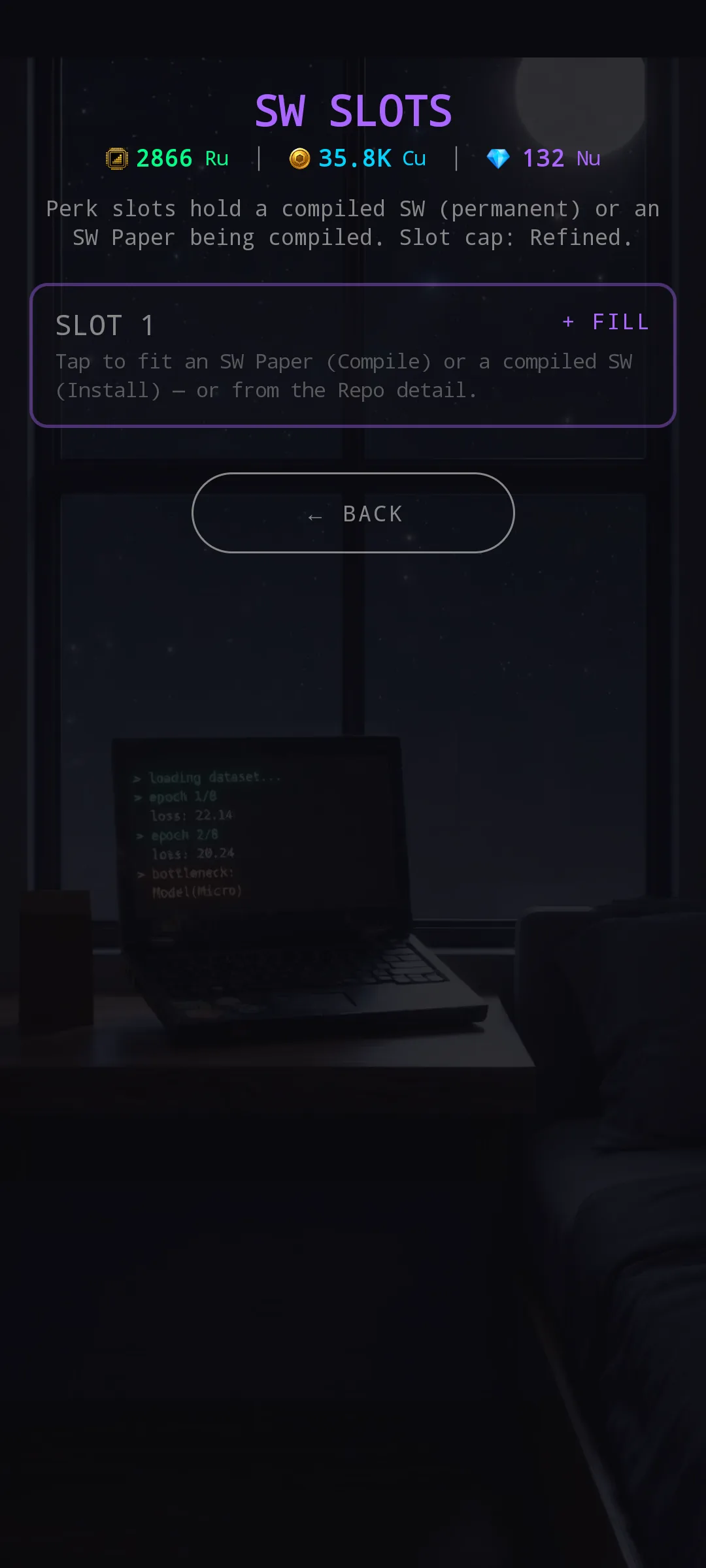
Models now come with perk slots, scaled to rarity:
- Baseline 0 · Refined 1 · Distilled 2 · Emergent 3
Two things you do with those slots:
- Install a finished program into a slot → raises the model’s sale value. The slot detail shows “SW Efficiency” — how much the software adds on the current model, and what it would add on a top-tier model. So you can see when it’s worth waiting for something better.
- Or compile a paper directly into a slot — the same slot that will eventually hold the finished software also runs the compile. Runs feed both.
The value logic:
- Better model = bigger bonus from the same software. On a micro chassis, barely a bump. On endgame iron, a real chunk.
- The bonus applies both to Black Market sales and to contract deliveries — no gate on either.
- Sell it or install it? A weak model? Sell the software raw. A strong one? Install it — the multiplier pays back many times over.
- Sell a model mid-compile? The game extracts the unfinished blueprint back into the Repo (no work lost), and you can finish compiling it on a different model without paying the fragment cost again.
This is only the first piece of a bigger system. Perk slots landed alongside the loot layer because they belong together — but there’s more coming on top of them. Details when they’re closer.
⚙️ Your build now shapes your loot
Modules you used to pick “just because” now shape how loot drops. Each lever scales with how much budget you spared for the module (smaller-penalty builds pull more weight):
- Search + Causal Reasoning and Goal Discovery + Goal Persistence → drop quantity.
- Memory + Introspection and Causal Episodes → drop rarity. Fair warning: a strong memory build will trade baseline drops for rares — so if you’re chasing legendary fragments you’ll also see fewer baselines. 😏
- Prediction → drop cadence — how fast the extraction blocks tick. And Context-Aware Prediction unlocks an extraction-rate estimate directly in the Run config, so you can see what a build is going to yield before you commit.
📈 Economy rebalance
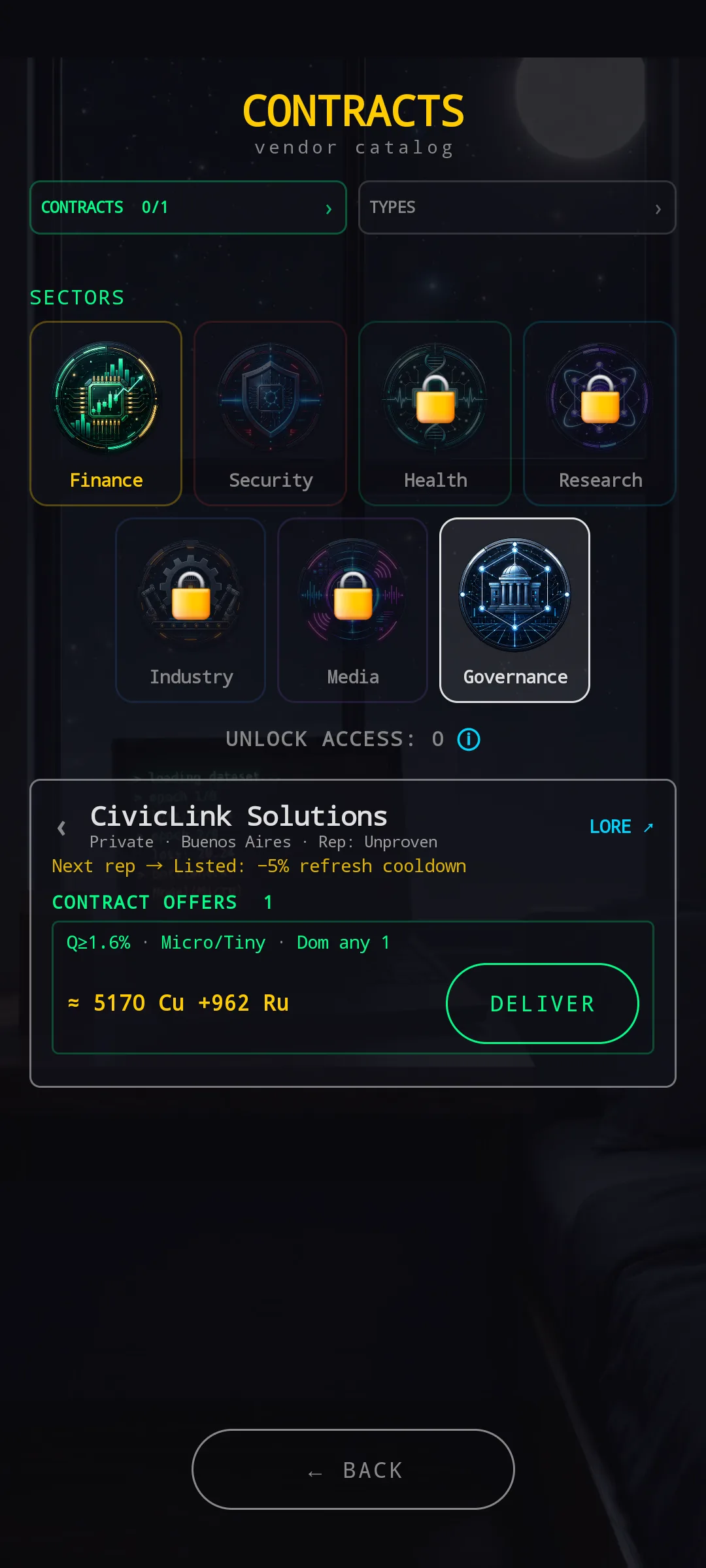
- Contracts — demand pulls you up. The starter sector (Governance) stays friendly, but each additional sector you unlock asks for one dataset tier higher. Small datasets are the new norm outside of onboarding — finally a real reason to upgrade, and a real reason to sell loot for Cu to afford it.
- Contracts — one-tap delivery. An Open contract on the board that your model can fulfil, and you have a slot free in the delivery list? Deliver it in a single tap from the offer — no more “accept → open the list → deliver.”
- A fully-maxed model can’t be milked forever. Extractions on a max-quality brain now build rising fatigue and frustration — you resolve it with combos, or you sell the model and move on. The idle-through-perfection loophole is closed.
🧹 Quality of life
- Retrain reworked. Once a brain has actually run, retrain locks — retraining a brain that has already worked is throwaway effort and the game now says so (sell it instead). Fresh brains, or brains that haven’t run yet, still retrain freely.
- Prediction module description tidied up — the tooltip now reads “reveals hidden aptitudes,” and the duplicate Abort Run button (which did the same thing as Stop Run) is gone.
- Module detail now uses custom icons instead of emoji placeholders.
- Under-the-hood fixes across the board — mid-compile blueprints survive contract deliveries, mid-compile blueprints survive retrains, and a lot of smaller cleanups.
Runs used to be idle. They’re not anymore.
— NeuroVault Research Systems