v1.8.0 — Breeding & Lending
The two mechanics that give a model a life beyond the sale. REFACTORING merges two saved brains into one — deeper slot, higher quality ceiling, more headroom — inside a chamber that can burn one, both, or neither. LENDING sends the model out to work on its own — SW carries the payout, quality carries the wear, and vendor SW preferences turn the loot chain into a real target for the first time. Plus the schema, the tiers, the trade-offs, and the reasons none of it is a shortcut.
Until now, a brain had exactly one future — sell it. You trained it, wrung it dry, and cashed it out to pay for the next one. This release adds two more futures on top of the first, and they compete: one where the model stays with you and gets deeper, one where it goes out to work while you don’t. The old sale doesn’t go anywhere. It just isn’t the only answer any more.
📦 The Archive is real inventory now
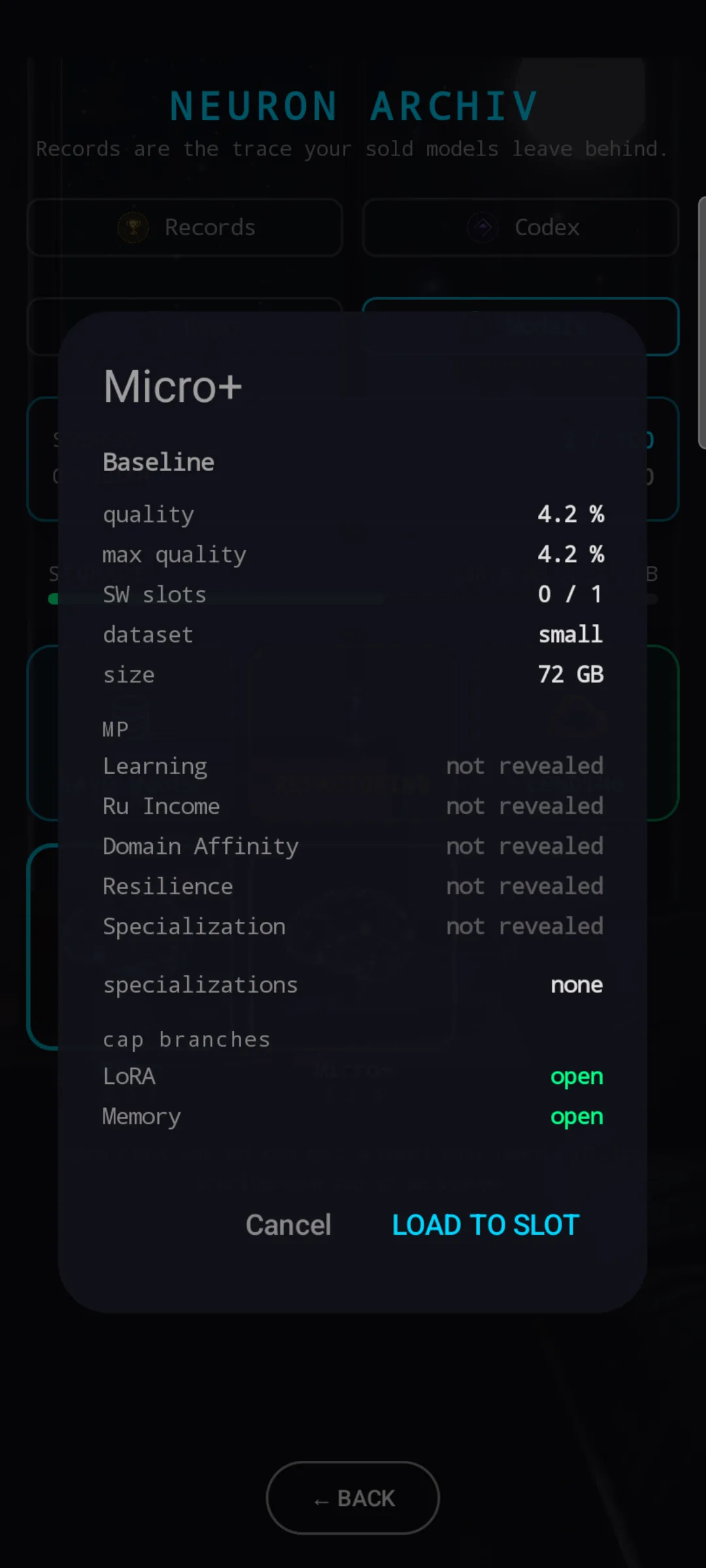
A model that reaches at least thirty percent of its class’s quality ceiling can now be saved. It doesn’t consume, it doesn’t sell — it goes into the second tab of Neuron Archiv (Repo · Models) and stays yours. It takes disk space, not headspace. And from that moment on, two things can be done with it that couldn’t before.
🔬 REFACTORING — two brains, one model
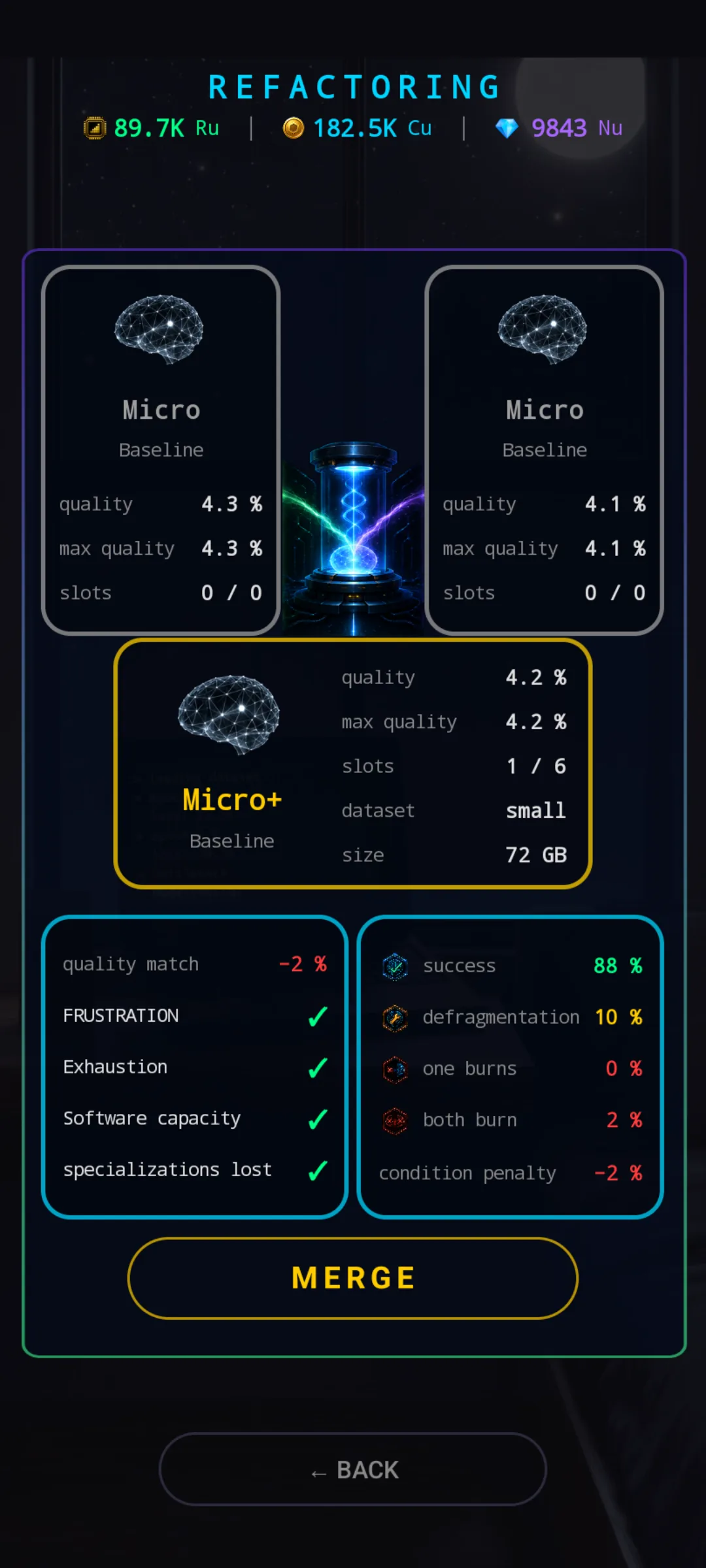
You take two saved models — same class, same rarity, same depth — and send them into the chamber. What comes out isn’t the average of the two. It’s a new model that inherited from both — quality, MP stats, dataset, specializations, installed SW — plus one extra slot.
But the chamber isn’t a vending machine.
It can fail in three ways, and the rarer the parents, the more likely it does:
| success | defragmentation | one burns | both burn | |
|---|---|---|---|---|
| Baseline | 90 % | 10 % | — | — |
| Refined | 84 % | 11 % | 4 % | 1 % |
| Distilled | 78 % | 11 % | 9 % | 2 % |
| Emergent | 70 % | 6 % | 18 % | 6 % |
Baseline never burns — its only bad outcome is defragmentation, a repairable state, not a loss. That’s by design: the bottom branch is the deterministic path for the unlucky. Deterministic doesn’t mean you don’t fail. It means you always arrive.
The chamber isn’t automatic
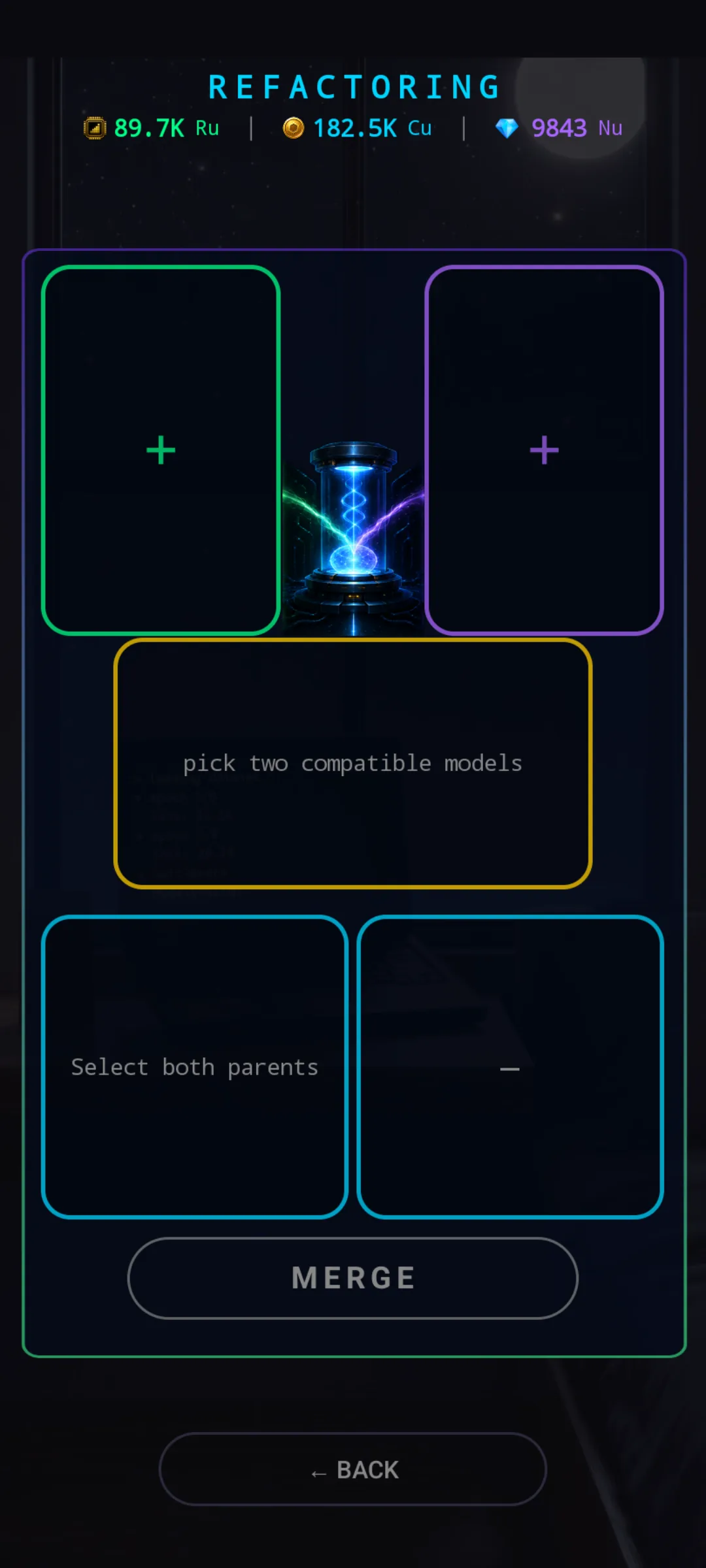
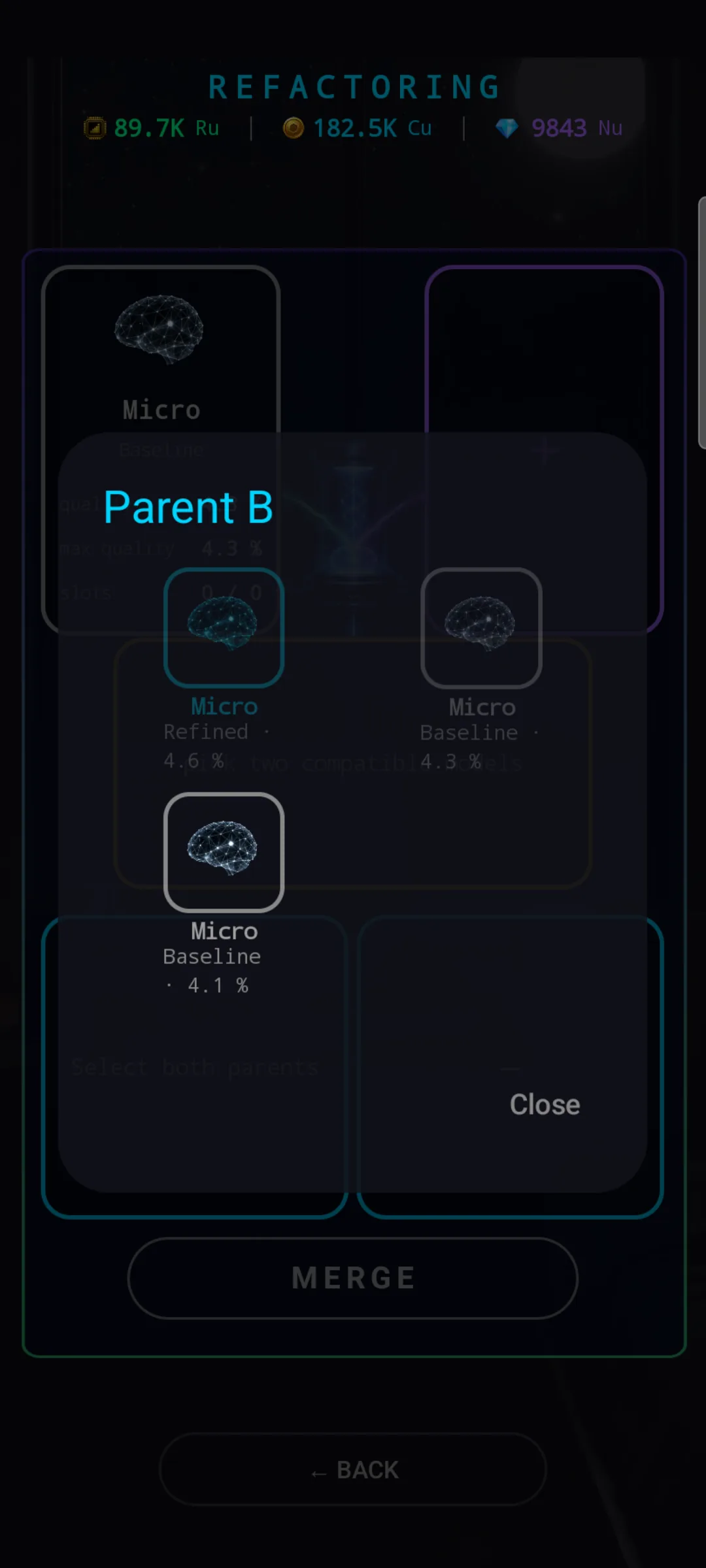
You need to bring the two parents to it. Class, rarity and depth all have to match. The screen holds two slots, one on each side of the chamber; you pick one, then the other. Below the parents you get a live compatibility panel and a live probability panel that update the moment the second parent lands — so the moment before you press MERGE is the moment you find out what you’re really doing.
The child in the preview appears in a third colour so it reads as new, not as either parent. You see its quality, its slot count, its dataset, its size — everything the merge would hand you if it succeeds — before you commit.
Depth is the anvil
Every successful merge adds a plusko to the child — +, ++, +++. And every next step is materially harder than the one before: the second step has 1.6× the failure chance of the first, the third 2.4×.
What are you buying with all that risk? Three things.
A higher quality ceiling. Every plusko raises the cap the model can ever reach — around one-and-a-half percent for baseline, eight for emergent, more per subsequent step. On a Micro that’s a rounding adjustment. On a Colossus it’s the difference between eighty and a hundred. This is the reason you keep a model instead of selling it.
A slot, and a higher SW level cap. Each plusko adds one slot for SW and lifts their level cap by fifty — from 50 on the base to 200 on +++. How many slots you end up with is a function of both rarity and depth: a baseline at +++ carries three SW, an emergent at +++ carries six.
Baseline has no slots at all until you breed it — for the bottom branch, the first merge is the entry ticket into the SW economy, not a bonus.
Carelessness costs
You can send a model into the chamber even if it just came off a hard run — frustration and exhaustion aren’t a lock, they’re a price. Same with a quality mismatch between the two parents. All three chip into the success chance and push the outcome toward the worst end.
Which means “baseline never burns” holds precisely as long as the parents match. Send two exhausted mismatched brains in and you can absolutely lose both.
And at the top, there’s a door
A model at +++ can be merged with a model one class up. The child ascends — but its quality and MP get averaged in the process, so it’s a worse individual than one bred from two matched parents at the higher tier. What you paid for is that you carried SW levels one tier up — and there is otherwise no way to do that at all, because SW level belongs to the model-SW pair, not to you.
The +++ doorway is the one hard-earned bridge between tiers. Everything else respects the class boundary.
When it works, it looks like this
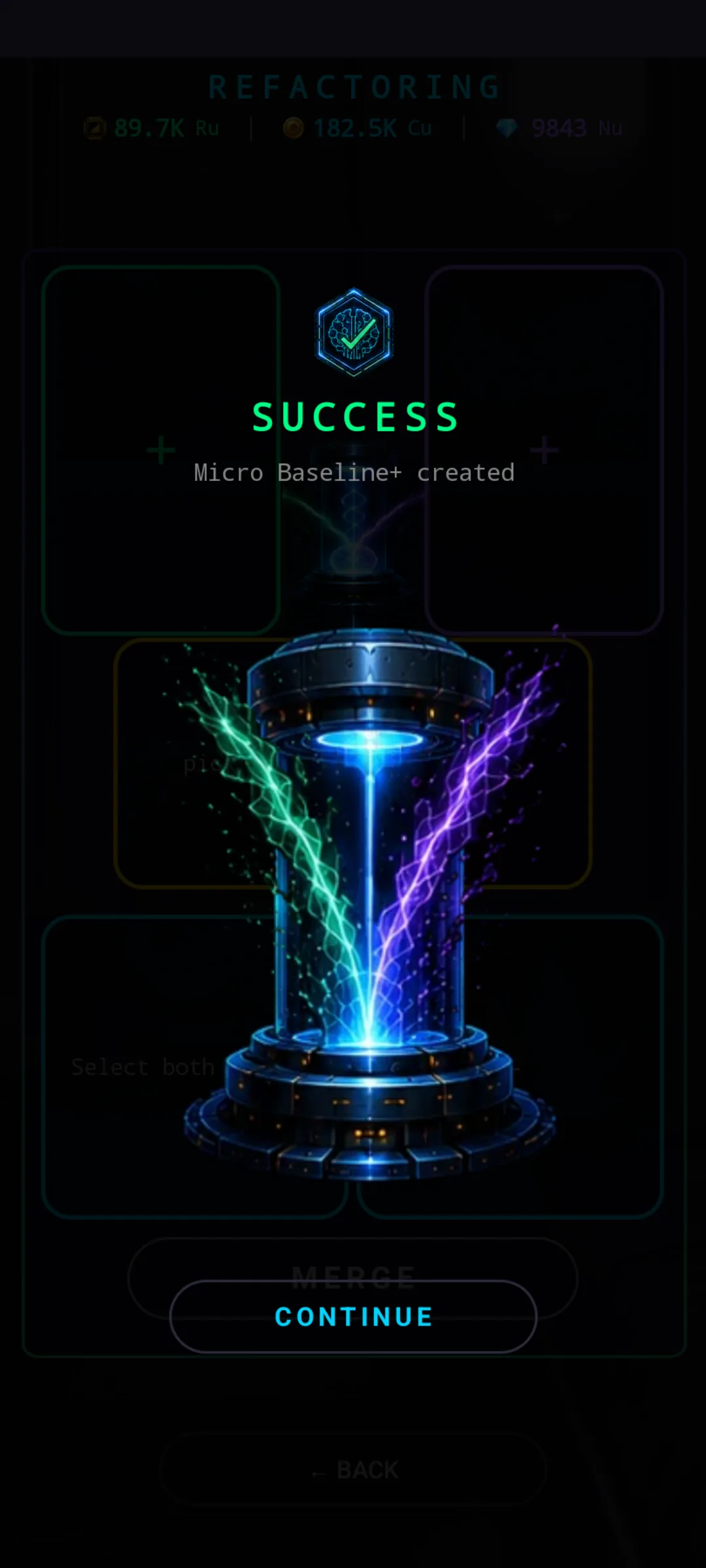
Green from the left parent, purple from the right, blue up the middle — the new model at the intersection of both. It’s the only screen in the game where you’ll see the two source colours meet, because it’s the only screen where two models become one.
The failure states have their own animations too. Defragmentation shows what a repair looks like — the model returns, just needs a paid cleanup step before it can be used. One burns and both burn are what they sound like. You’ll see them once each and remember for a while.
💼 LENDING — a model that earns while you don’t
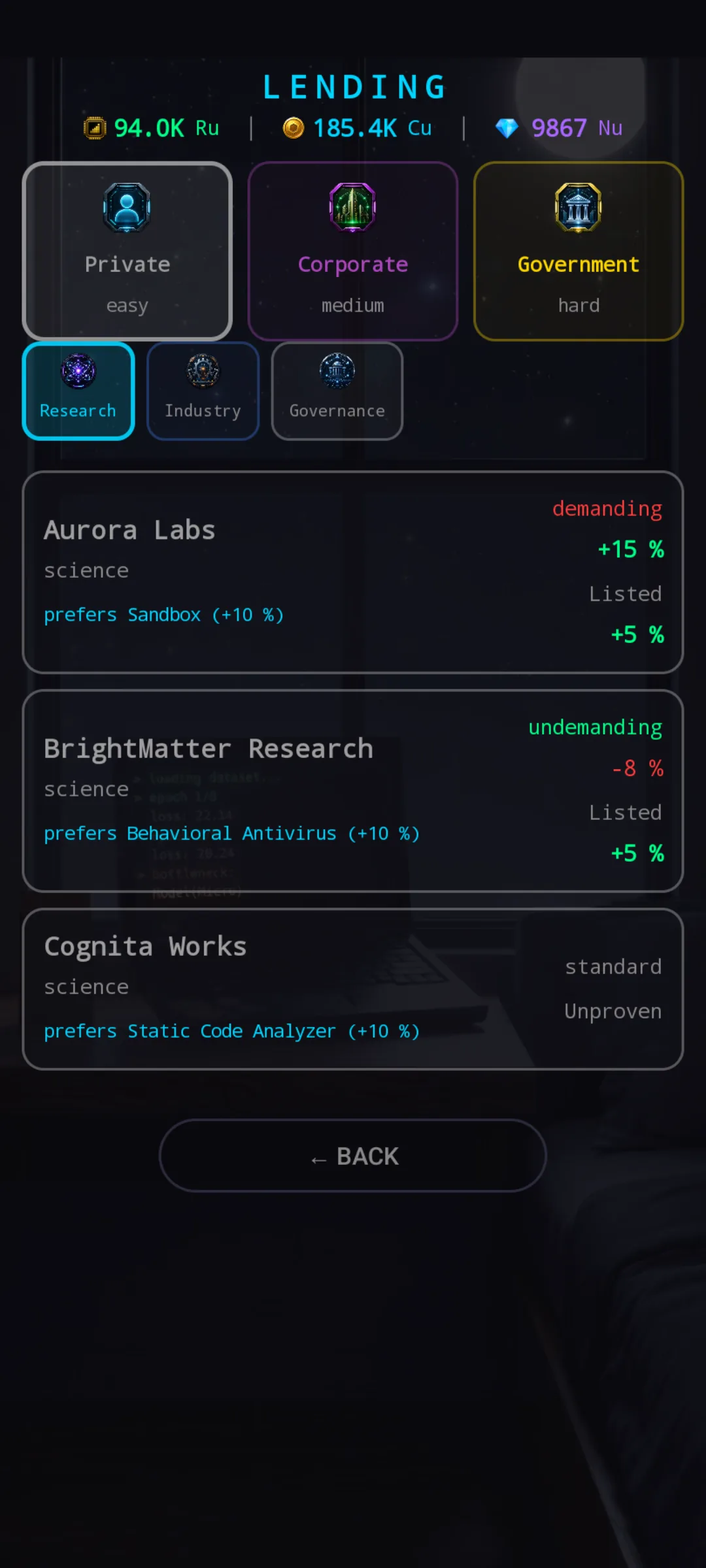
A model with a compiled SW can be rented out. Vendors ask for short-term access — they don’t want to buy the certified brain, they want to borrow it for a while — and you pick which of them is asking. The catalog shows sector, class, difficulty, base rate, and the vendor’s SW preference in a single card.
The model doesn’t go anywhere. The vendor buys access, not hardware; the brain stays on your disk and runs through the cloud. There’s no way for it not to come back.
You choose the window
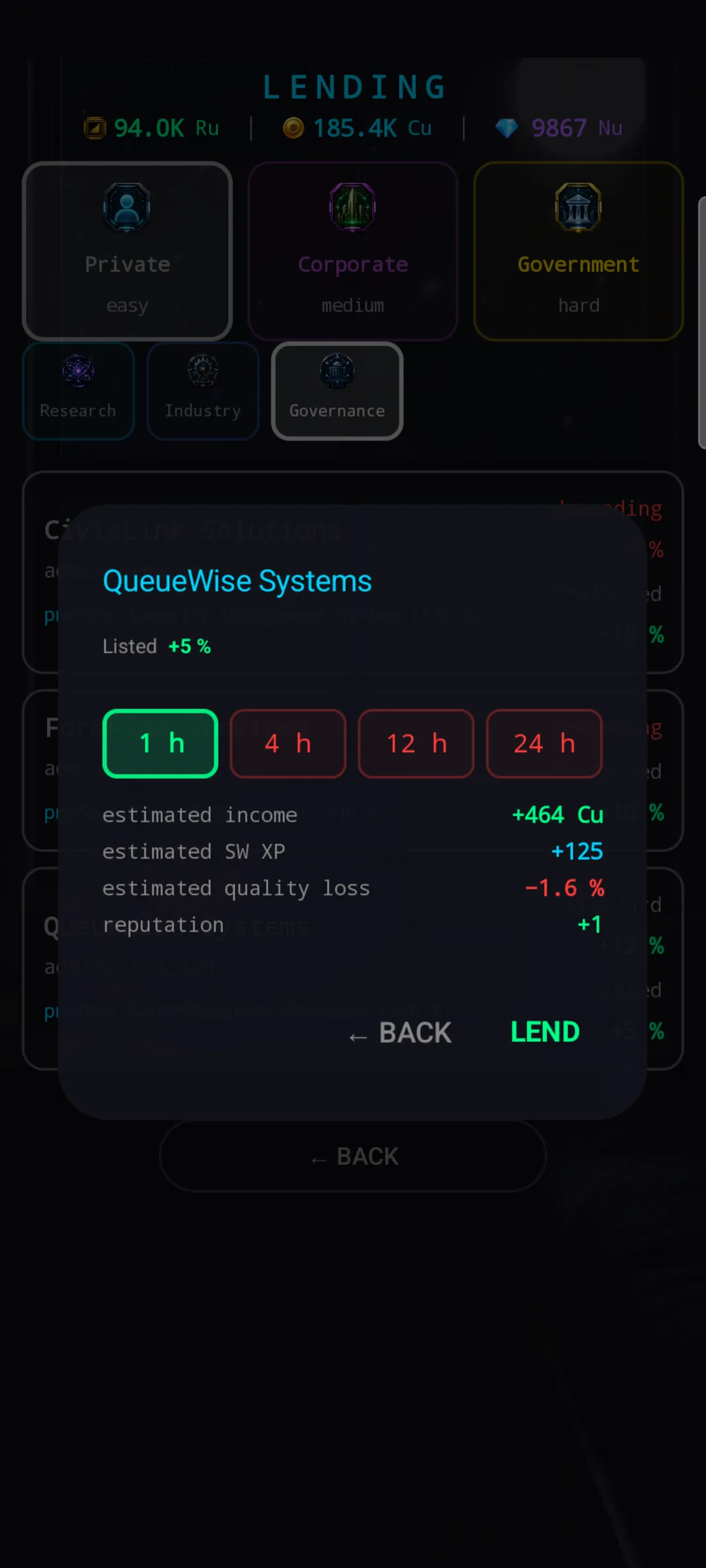
The offer doesn’t tell you how long. You do — 1, 4, 12 or 24 hours — and for each length you see the estimate: how much Cu, how much SW XP, how much quality it’ll cost, and what it’ll do to reputation.
That estimate extrapolates from the first hour. The longer the window, the more it diverges from reality — because the rate falls as quality falls, and the estimate ignores that. It’s the vendor’s offer, not a guarantee. When the loan returns you get a summary with the actual numbers, and that gap is right there in the difference column.
Paid in quality, not in the model itself
Lending doesn’t destroy the model. It drains its quality — which you can rebuild with runs. So the price is your time at your own rig, plus the hardware wear that comes with those runs.
Which surfaces a rule worth knowing early: the model has to match the hardware. Income hangs off the model; repair hangs off the rig; the two axes are independent. A Micro on a starter rig will pay for itself; the same Micro on a builder-tier rig will cost you forty thousand in repairs against a few hundred Cu of income. Upgrading the rig doesn’t age your stable gradually — it ages it all at once.
SW finally levels up
Installed SW accrues XP while deployed and levels. That level does two things: the model survives longer (so it can take harder contracts) and the model is worth more — one SW at L50 doubles the model’s price, three SW at L100 quintuple it.
SW rarity here is a trade, not a ladder. Common baseline SW levels faster but pays a base rate per hour. Rare emergent SW levels slowly but pays a meaningful premium per hour. Refined and distilled sit between the two curves. And because XP is split across all installed SW, a wider rack levels every piece more slowly. The interesting builds are mixed: a levelled baseline holds the survivability line, an emergent alongside brings the money — and you get to decide whether you want one strong piece or three average ones.
Three difficulties, and why you move up
Private vendors are calm, corporate are standard, government are hot. The difference isn’t just money — a harder contract wears the model down orders of magnitude faster, and until your SW is around level twenty, hard will chew through your model faster than an hour of clock time.
So the move up doesn’t come because the game allows it. It comes when your rack starts absorbing the damage — and you notice, because it starts paying.
Reputation carries across, now
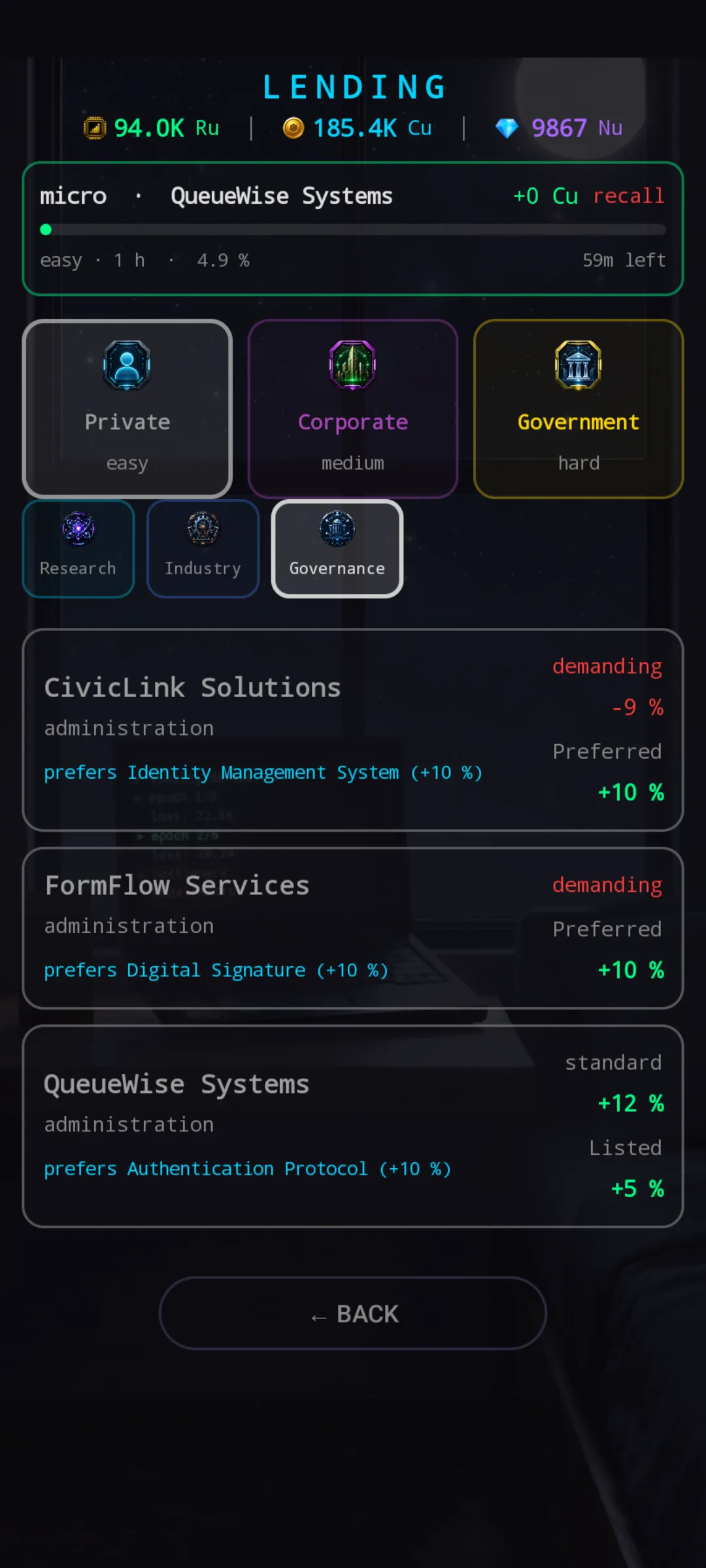
Vendor reputation isn’t a contract-only concept any more. A completed loan window raises it; an incompleted one drops it — and the penalty is measured in uncovered hours, not as a binary miss. Promise a full day and drop after three hours, and the vendor was without coverage for twenty-one, and they know that.
Higher reputation means higher rent — up to a quarter more. Contracts remain the primary track — a sold model stays with the vendor, a lent one you only had them for a while — but lending is now the second income stream.
Vendors have preferences
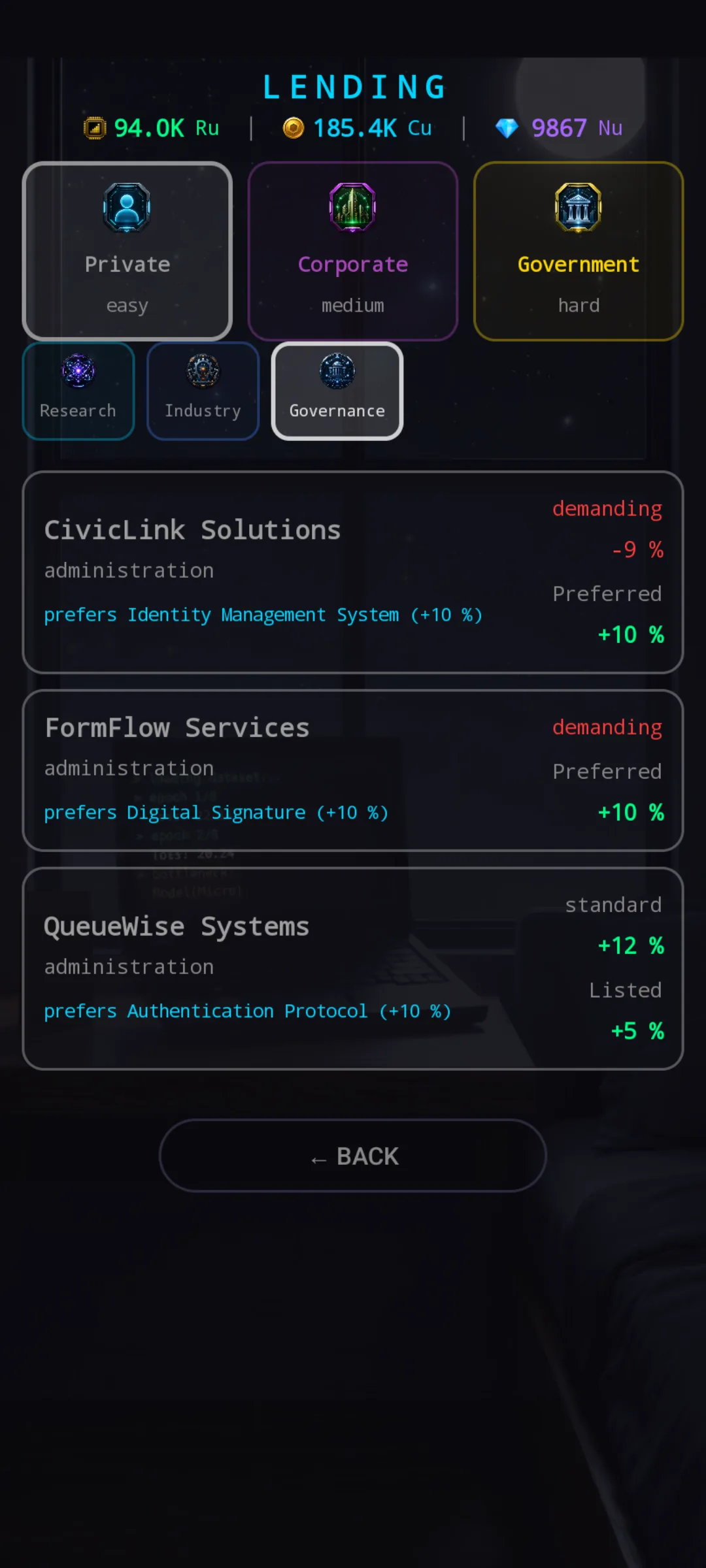
Vendors pay a premium for SW from a corpus their sector uses, and an additional premium for the specific SW they want right now. They never require it — it’s an offer, not a filter. But it’s the first time the loot chain has a target attached: I want this SW, and I know who’ll pay for it.
The catalog surfaces both signals per card: prefers <SW name> (+10 %) on the sector-appropriate one, and the model-vs-vendor multiplier in the top-right (Preferred +10 %, Listed +5 %, Unproven). The move from picking any vendor to picking this vendor for this model — because the SW you baked in weeks ago happens to be the one their whole desk is asking for — is the piece that changes the shape of the game.
✨ What’s best about all this
Before 1.8.0, a model had one fate and one use. Now it has three, and they compete with each other: sell it now, send it to work, or make it a parent.
Each of those paths pays it back differently. And none of them is right forever.
And this is only the first pass. Lending, refactoring, and SW leveling are the foundation for the next layers of the system — future updates keep building on top of what shipped today.
— NeuroVault Research Systems