v1.8.4 — Improve Rarity
The Refactoring chamber gets a second mode. Rarity used to be the one thing you couldn't grind — same-rarity parents in, same-rarity child out, so a run of unlucky rolls kept you at baseline forever. IMPROVE RARITY changes that. Two same-rarity models become one child a rarity higher, paid for in bred depth instead of Cu. Costs slots-for-nothing (rarity + depth = zero-sum), keeps installed SW, and — for the first time — makes bad luck something you can work with.
Almost everything in this game can be ground out. Quality gets trained. Domains get mastered. Fragments accumulate and merge. Contracts get filled, reputation gets built, SW levels.
Rarity didn’t. It was the one thing you either rolled or you didn’t. And that would be fine — lotteries have a place — except rarity gates content. Refactoring needed two parents of the same rarity, and the child inherited that rarity, so a run of baseline rolls stayed a run of baseline rolls. One operator put it exactly right: “I have a distilled in the archive, but the drops keep coming baseline.” There was no move to make.
This release adds one.
🔧 A new mode: IMPROVE RARITY
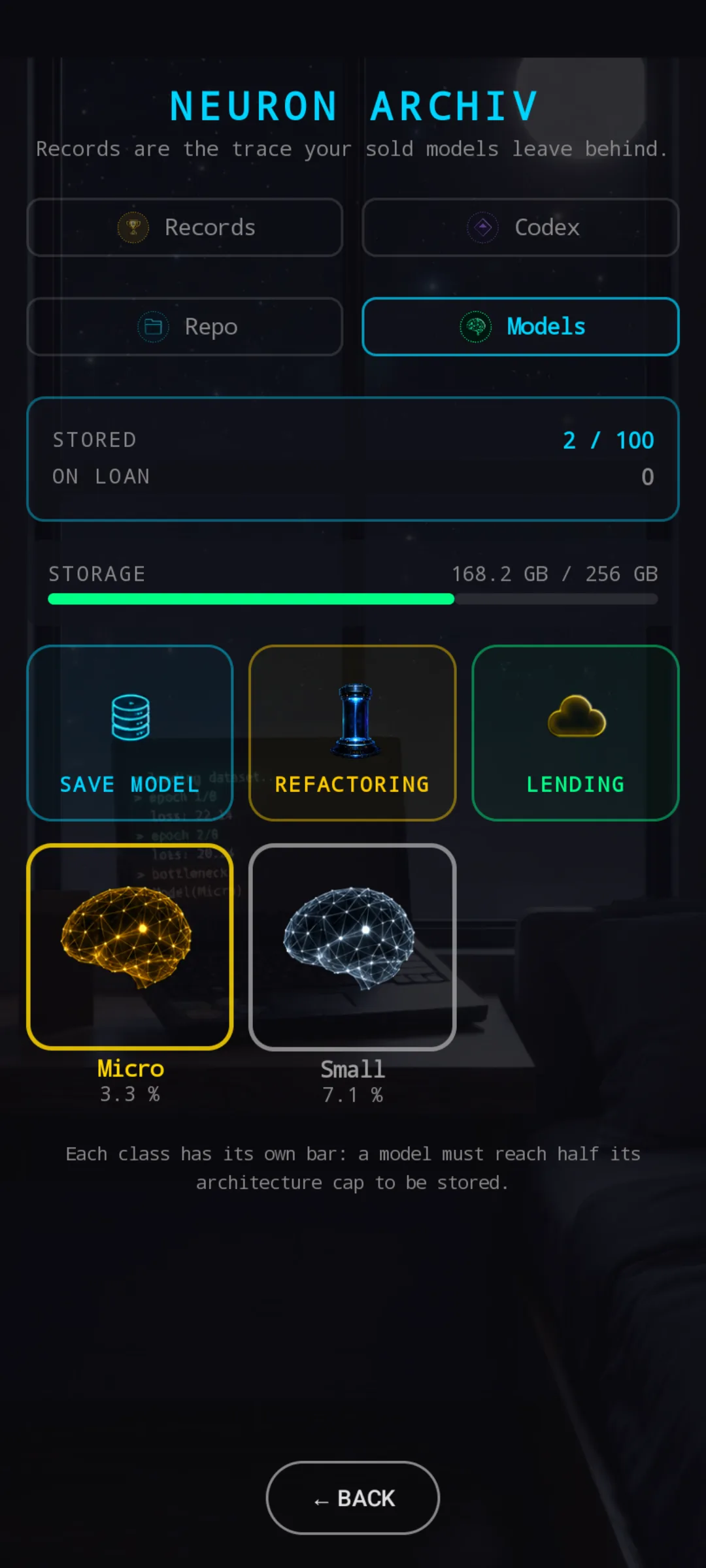
The Refactoring tile in the Archive now has a ⚙ gear on it. Tap the chamber and a mode picker opens:
- DEPTH — what the chamber has been doing since v1.8.0. Two matched models produce one deeper child:
+→++→+++. - IMPROVE RARITY — new. Two matched-rarity models produce one child one rarity higher.
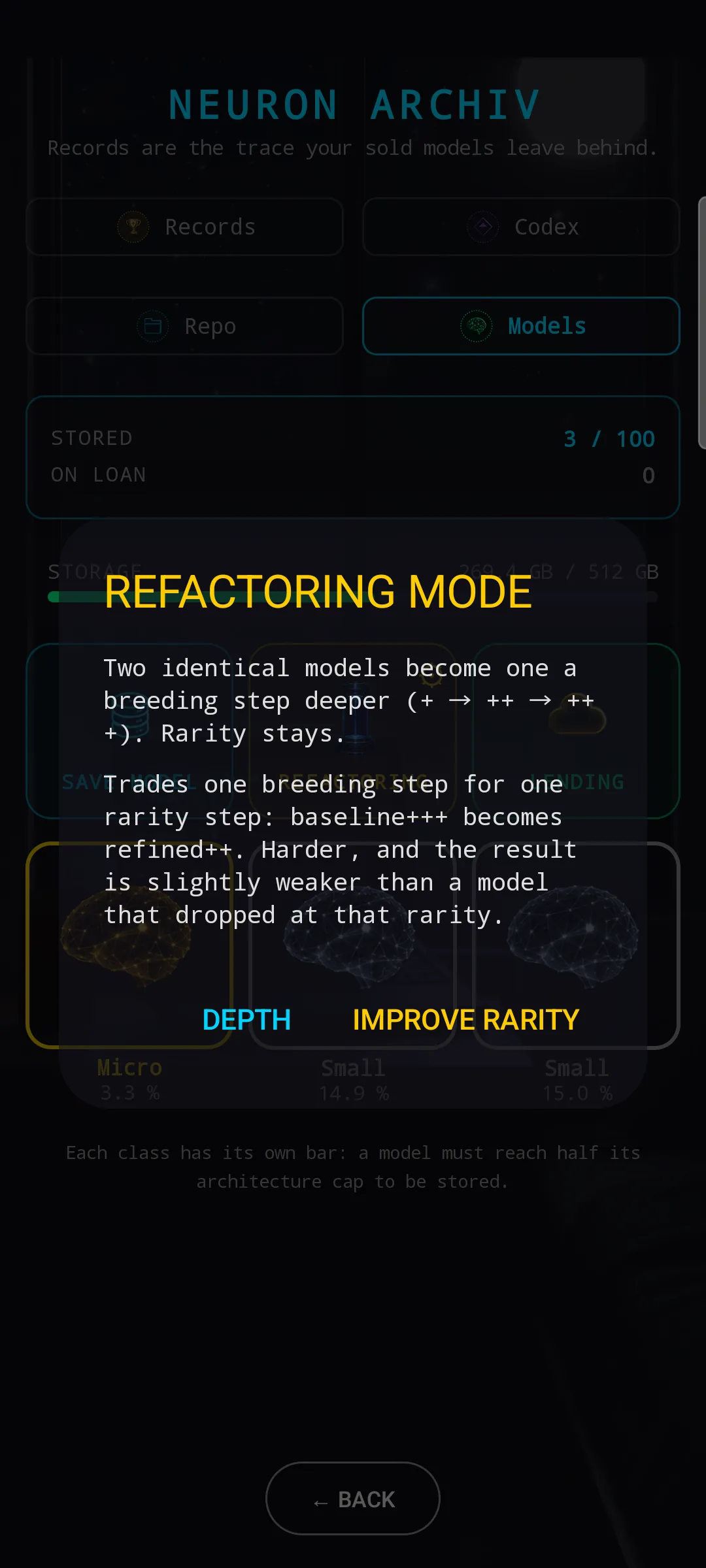
It doesn’t cost Cu or Ru. It costs plusko (bred depth):
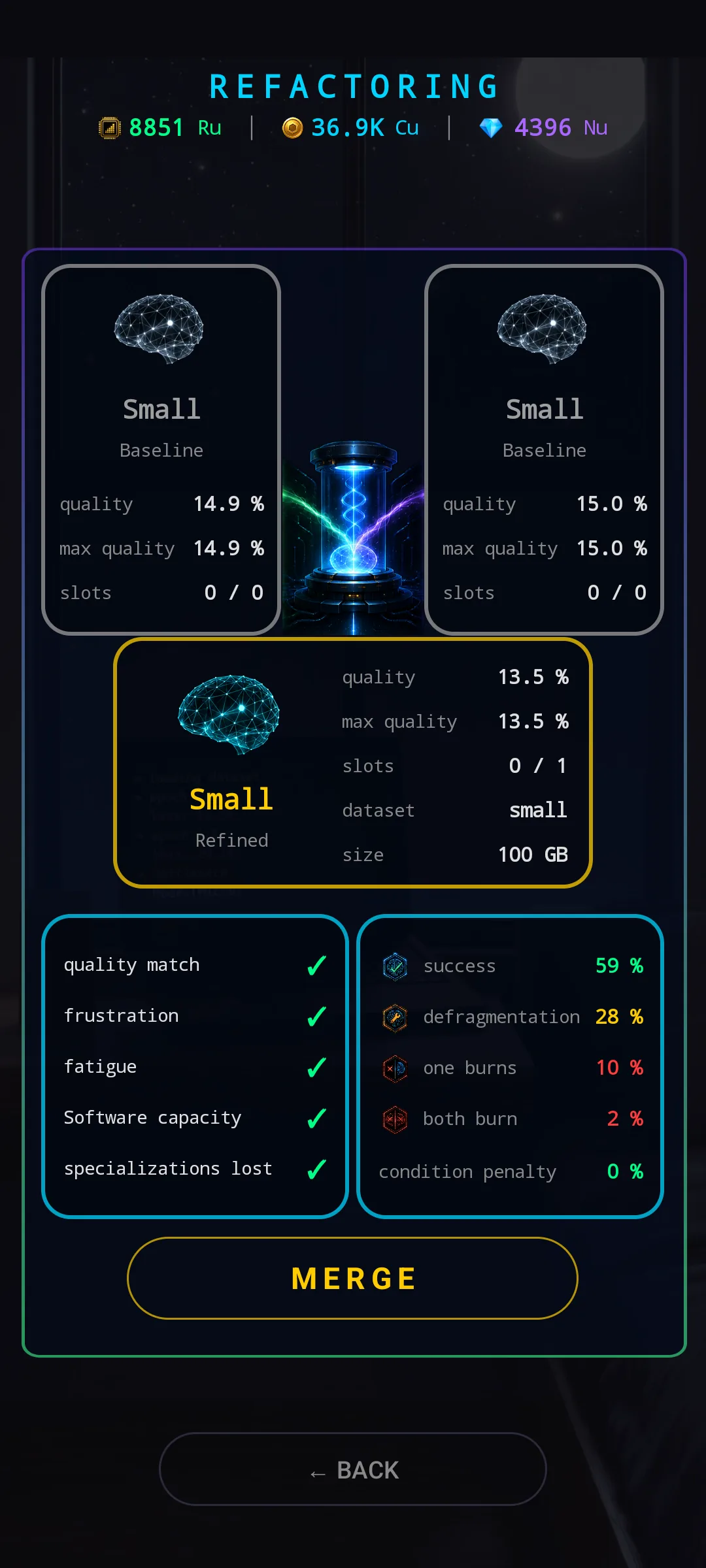
baseline+++  →  refined++
baseline++   →  refined+
baseline+    →  refined
baseline     →  refined     ← nothing to trade, pays with risk
You’re trading bred depth for rarity. And because slot count is rarity + depth, the trade is zero-sum on slots — you don’t lose a single slot at any step. Installed SW stays where it was.
A model with no pluskos to give can also promote — it just does so with much lower odds, and it gains a slot for the effort (because the higher-rarity base carries more slots by default).
📊 What it actually costs
As much as it has. This is not a shortcut, and it isn’t meant to be.
Success rate rises with the pluskos you sacrifice and falls with model size. On a Micro, where the model is cheap and fast:
| parents | baseline → refined | refined → distilled | distilled → emergent |
|---|---|---|---|
+++ | 89.9 % | 78.4 % | 57.1 % |
++ | 84.4 % | 68.2 % | 42.8 % |
+ | 76.9 % | 52.3 % | 27.3 % |
| unpluskoed | 66.0 % | 24.2 % | 17.2 % |
On a Colossus those same attempts are roughly five times less likely — 64 %, 42 %, and 21 % at +++, and about four percent for a bare distilled promotion.
That’s deliberate. Micro models are cheap and fast to build, so they’re where you’re supposed to experiment. A Colossus is an hours-long investment, and promoting one is meant to be a rare attempt, not a routine.
⚖️ Manufactured isn’t the same as natural
A promoted model is slightly weaker than a model that rolled that rarity on its own. Up to ten percent lower on max quality, learned quality, and MP stats.
How much of the ten percent you actually pay is set by the MP stat Specializace on the source model. A hundred points is a clean transition with no loss. Zero is the full ten percent hit. That stat was quietly waiting for the specialisation system to catch up with it; now it has a second, related job: how well your brain survives being reshaped.
And because the penalty is calculated fresh on every promotion, a baseline → emergent path across three promotions leaves you at roughly three-quarters of a natural emergent’s numbers.
A rolled rarity is always better. Always.
🔥 When it fails
Same three outcomes as ordinary Refactoring: defragmentation, one burns, both burn. One important difference:
Risk is calculated by where you’re going, not where you came from.
A baseline model at ordinary refactoring never burns; it has nothing to lose. But an attempt to promote a baseline to refined does carry burn risk, because that roll is being computed at refined-tier stakes. A baseline itself doesn’t burn — the attempt to make it into something more does.
And if you have Ministry of Continuity coverage, it applies here too. Finally, something you’ll be doing repeatedly for it to protect.
✨ What this changes for how you play
Before this release, a baseline model had one future — a few runs and the Black Market.
Now it has a second. You don’t have to sell it. You can put it in the archive and wait for a second one. And if bad luck holds long enough, you accumulate the material and make the rarity yourself.
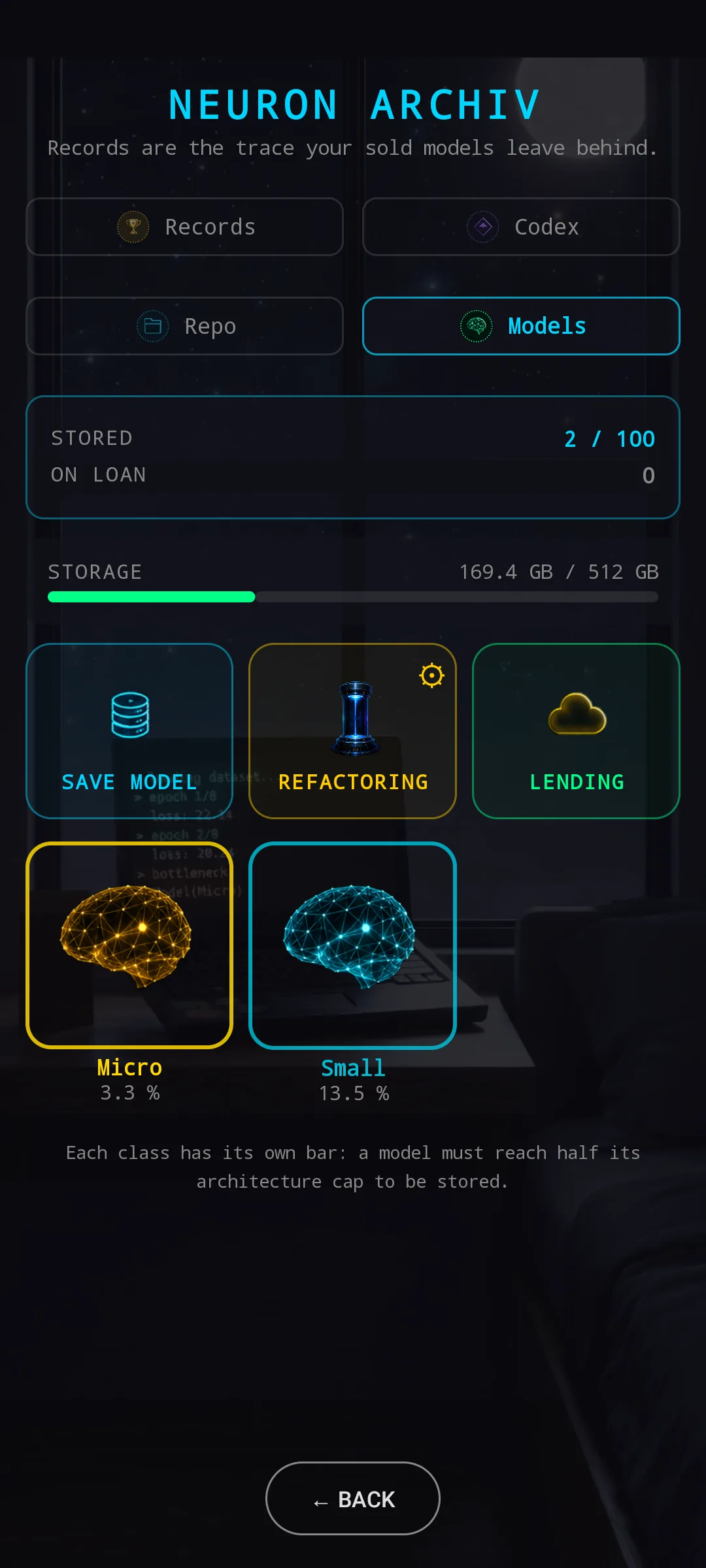
Nothing here forces the workflow. Until you send two models into the chamber, they’re just models. If a rare rarity rolls organically in the meantime, sell the baselines and you’ve lost nothing.
Rolling is still the faster path. It’s free and it’s instant. This isn’t a replacement for it; it’s insurance against a streak that isn’t coming. And for the first time, bad luck is something you can work with.
— NeuroVault Research Systems