Knowledge Domains — corpora, ownership, mastery
What the brain actually learns during a run. Domains are organized under corpora (Globalset, Source Code, Formal Methods, Empirical Sciences, and Combined Corpus); you buy them individually and then activate them on the Brain screen. Their real job is to fuel model quality — and one maxed domain is worth more than three half-mastered ones.
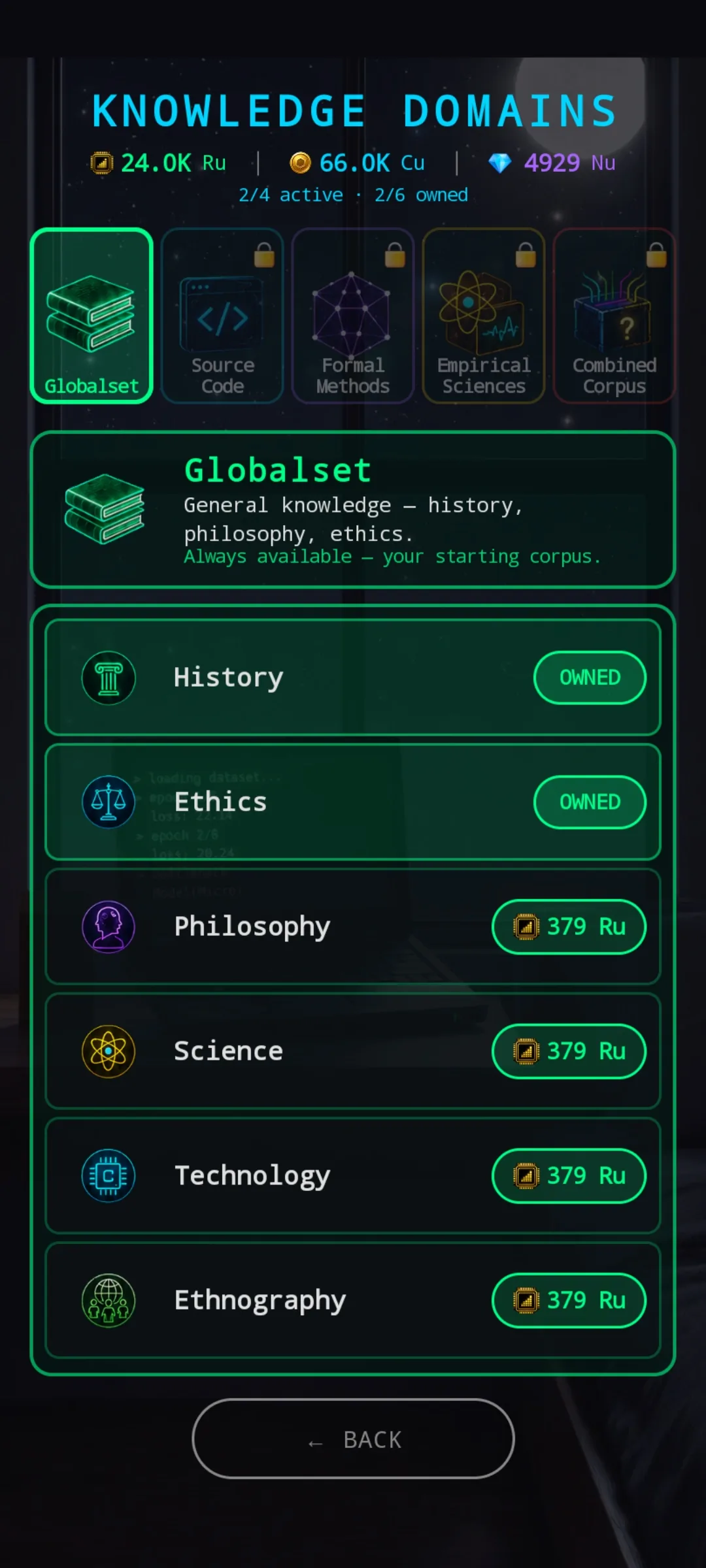
At a glance
The domain system has four layers, and the ownership state moves through them in order:
- Corpus — the container. Five of them exist. Globalset is free from run one; the other four are gated behind a Ru purchase.
- Domain — an individual topic inside a corpus (e.g. Ethics under Globalset, Algorithms under Source Code). Bought with Ru once the corpus is unlocked.
- Active — an owned domain that is currently switched on for the brain's next run. You choose which owned domains are active on the Brain screen, subject to your slot cap.
- Mastered (maxed) — an active domain that has been trained to its ceiling. This is the state contracts actually care about.
Brand new? Start with Getting Started for the basic loop, then come back here for what to actually spend your first Ru on. Short answer: probably not a new domain.
- The five corpora
- Buying a domain — OWNED state
- Active vs. Inactive — the Brain-screen toggle
- Slot count — where the "2/4 active" number comes from
- Mastery — one maxed domain is worth ~2 % quality
- Contracts and "required" domains
- Quick tips (especially for the first hour)
The five corpora
Corpora are containers for domains, and each one has its own theme:
The four specialised corpora each hold ten domains — that's forty unique domains in the game overall, plus the sixth mystery corpus on top:
- Globalset (free) — General knowledge: history, philosophy, ethics. The starting corpus, always available from run one. Ten domains inside, including History, Ethics, Philosophy, Science, Technology, Ethnography (and four more).
- Source Code (Ru unlock) — Programming, algorithms, computer architecture. Ten domains including Algorithms, Structures, Paradigms, Architecture, Databases, Networking.
- Formal Methods (Ru unlock) — Mathematics, logic. Ten domains including Algebra, Calculus, Discrete, Matrices, Probability, Statistics.
- Empirical Sciences (Ru unlock) — Natural sciences. Ten domains including Physics, Chemistry, Biology, Genetics, Neuroscience, Perception.
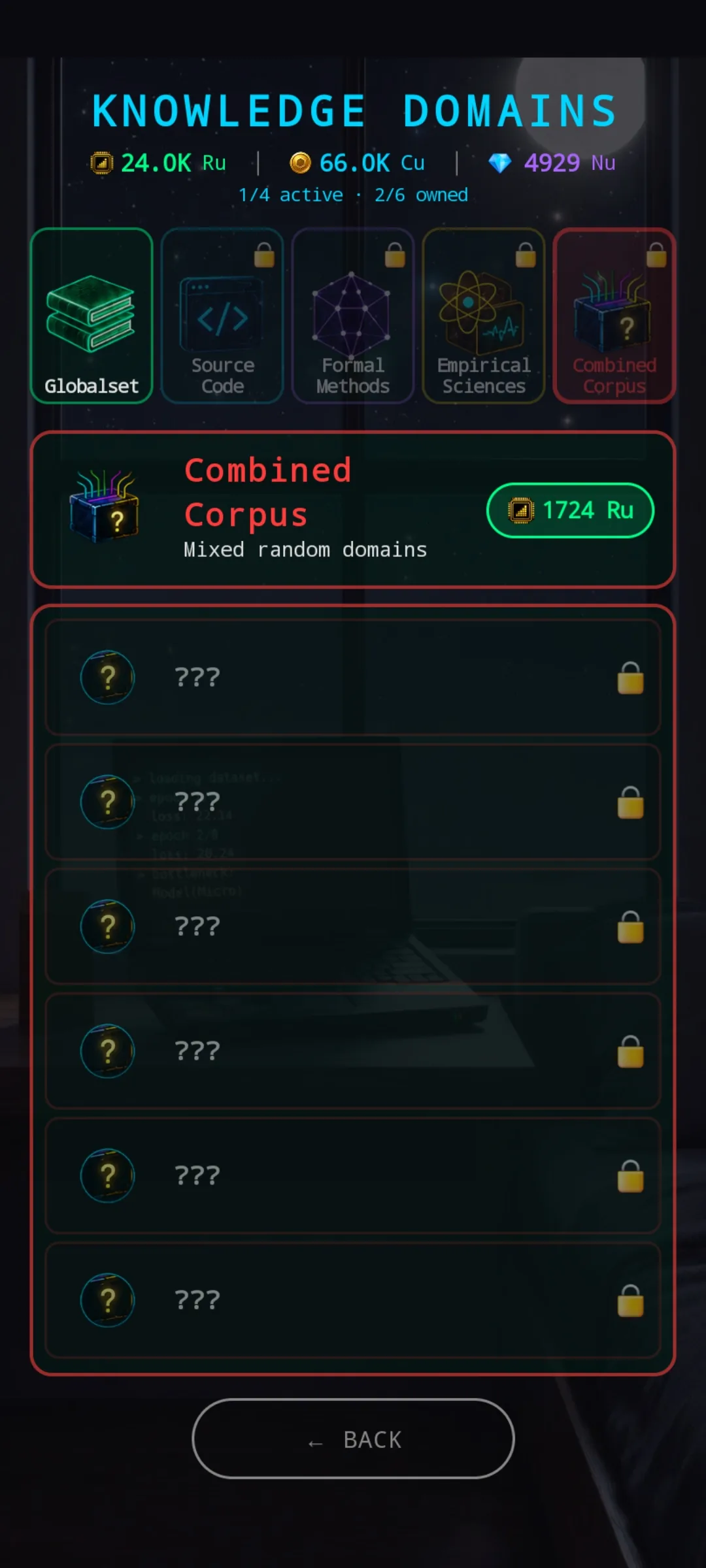
- Combined Corpus (Ru unlock, cheaper than the others) — Mixed random domains. Six mystery slots, two drawn from each of the three purchasable corpora (Source Code, Formal Methods, Empirical Sciences). You don't see which specific six until you own it. Cheaper because you're paying the discount on the uncertainty — and because it's a curated cross-section, not a whole new corpus.
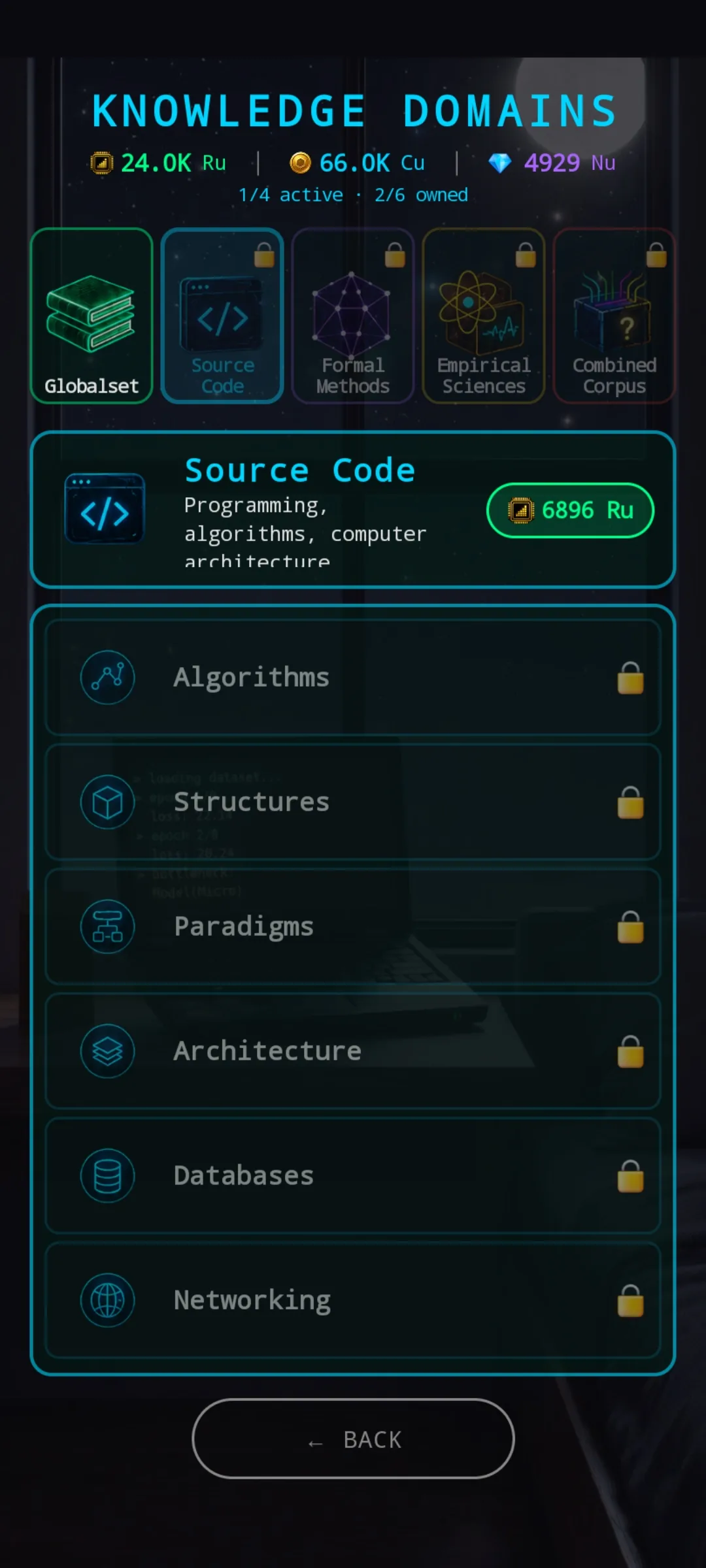
Tapping a locked corpus shows the buy button and the domains it contains — so you can see what you'd be getting before you spend. Nothing purchasable inside is available until the corpus itself is unlocked.
The Combined Corpus is the interesting outlier — its price sits materially below the specialised corpora, but its six slots are hidden until purchase and stay hidden until you buy each individual mystery domain. For players who don't have a specific specialisation in mind, it's the cheapest way to broaden the pool — with the trade-off that you don't know what you'll get.
Buying a domain — OWNED state
Once a corpus is unlocked, each domain inside has its own Ru
price. Tap the row and pay to purchase — the row flips from
[price] Ru to OWNED and the domain
joins the pool of things the brain can train on.
Owning a domain doesn't mean it's active yet. That's the next step.
Active vs. Inactive — the Brain-screen toggle
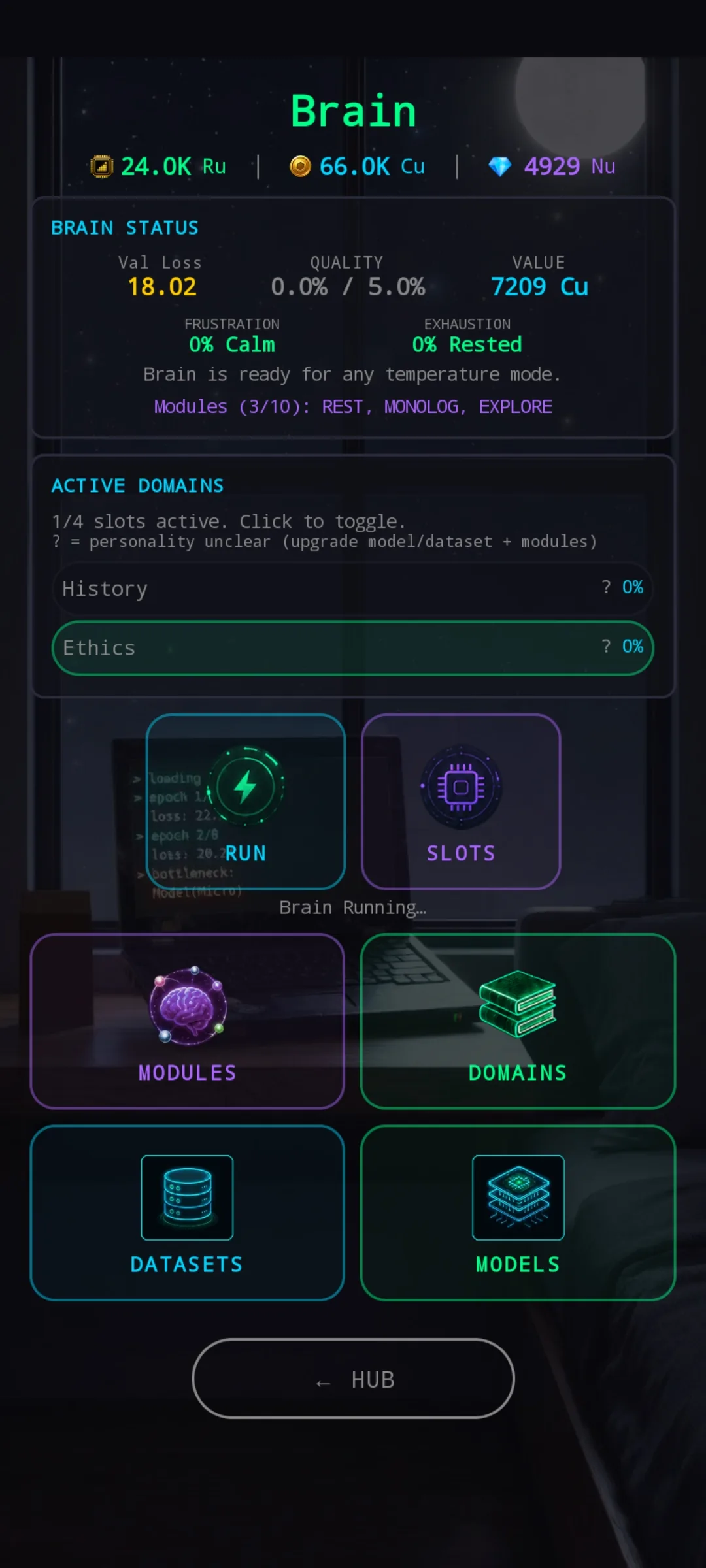
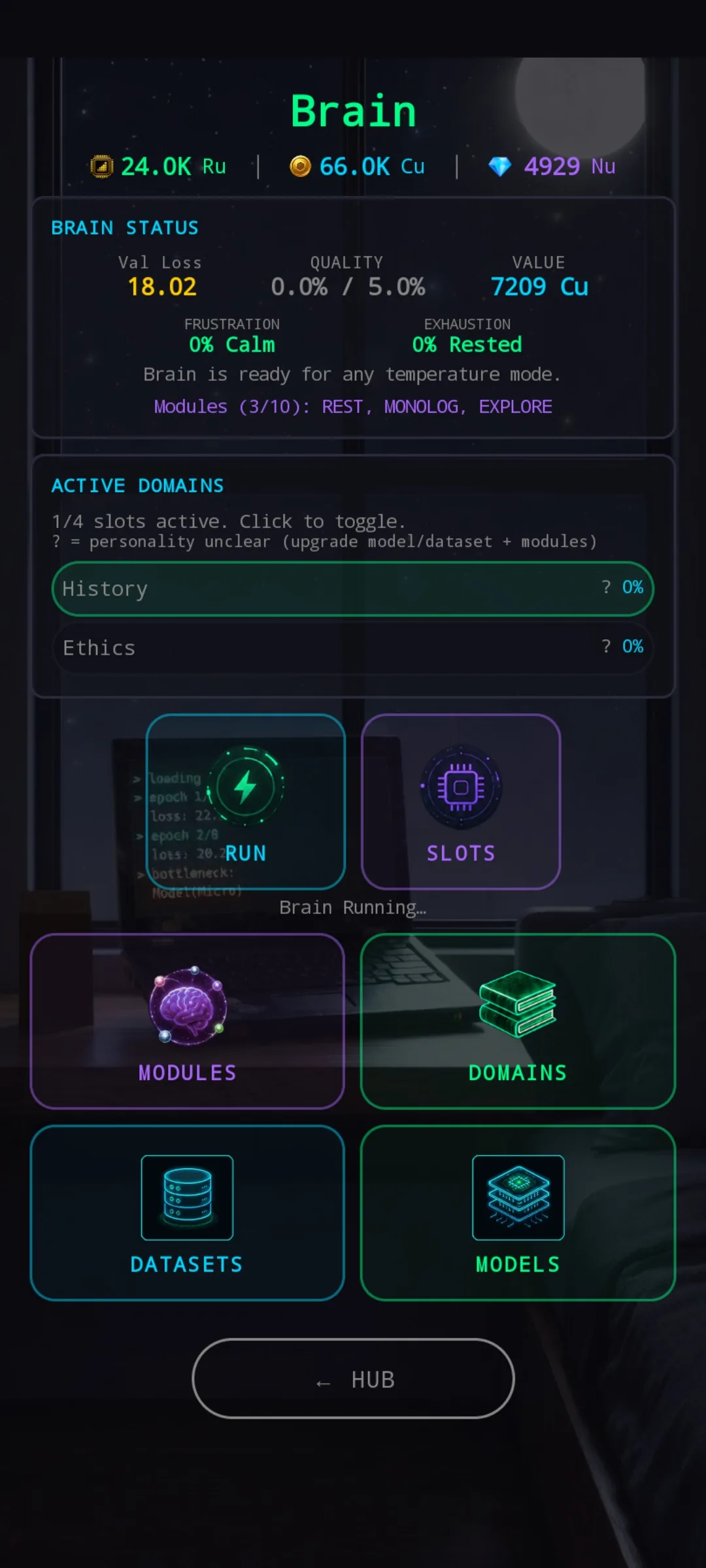
Owned domains are toggled on and off on the Brain
screen, under the Active Domains
panel. Each domain row is a chip — tap to switch
between active and inactive. The counter under the
panel header (X/Y slots active) tracks how many
are currently on out of your slot cap.
You don't have to fill every slot. Focused runs (one domain on) build mastery on that domain much faster than spread runs (three domains on). The Run Report tells you this explicitly in its Suggestions block — see the Run Report guide.
Slot count — where the "2/4 active" number comes from
The Y in X/Y slots active is a
combination of two things:
- Dataset baseline — bigger datasets grant more slots by default. This is set at pretrain configuration (see Pretrain Configuration → Dataset size).
- HDD extras — installed HDD adds slots on top of the dataset baseline (see Hardware screen).
Owning more domains than you have slots is legal — the extras just wait as inactive until you either free up slots (deactivate an already-mastered domain, see below) or upgrade the dataset/HDD to give the brain more room.
Mastery — one maxed domain is worth ~2 % quality
The number that actually matters isn't owned or even active — it's mastered. During runs, active domains gain mastery, and the more mastery on a domain, the more it contributes to the brain's final quality.
This is the reason the Run Report keeps hinting at "one active domain trains faster than several" — split attention across three domains means all three progress slowly, and you spend the entire brain lifetime finishing none of them. Focus one to the max, then rotate.
Contracts and "required" domains
When a contract on the Contracts board says it requires a specific domain, it means mastered, not just owned or active. Buying the domain and toggling it on before a contract deadline won't satisfy the requirement — the brain has to have actually maxed it.
This is the reason "specialist" brains beat "generalist" ones on higher-tier contracts: a brain with three maxed domains can fulfil three sets of contract requirements; a brain with six half-mastered ones can fulfil none. Pick the domains you intend to master before you activate them.
Quick tips (especially for the first hour)
- Don't buy a second domain until the first is maxed. This is the single biggest first-hour mistake. Owning three domains at 30 % each is worse in every way than owning one at 100 %. Master before you diversify.
- Deactivate mastered domains to make room for fresh ones. A maxed domain still counts against your slot cap even though it has nothing left to learn. Turn it off, activate the next unmastered one, run.
- Only one active domain = fastest mastery. Spread-focus feels efficient (progress bars everywhere!) but it's the slower path to any specific completion.
- Don't buy a new corpus before you've used most of the current one. Globalset alone has ten domains — ten mastered domains is a lot of contract flexibility, and they're free. New corpora are for when you've already done that work.
- Combined Corpus is a value play, not a strategy play. The price is right, but you can't plan a contract path around domains you can't see. Buy it when you have Ru to spare and want to broaden the pool — not when you need a specific capability.
- Read the Run Report's Suggestions. When it says "one active domain trains faster", it's not being polite — the game is telling you exactly what's costing you throughput this cycle.