Lending — send a model out to earn
The second thing you can do with a saved model — rent it to a vendor for a short window. The brain stays on your disk; the vendor buys cloud access. Cu comes back, quality goes down, SW inside the model levels up. This page covers the catalog, the window choice, the SW leveling curve, and the vendor preferences that turn the SW loot chain into a real target.
At a glance
Lending sends a model with at least one installed SW to a vendor for a short window. What happens:
- The vendor pays you Cu per hour for the duration you chose
- The model's installed SW gain XP and level over time
- The model's quality drains while it's out — you rebuild that with runs later
- Your reputation with that vendor moves based on how well the loan window is honoured
Prerequisite: at least one model in the archive with a compiled SW installed. A model with an empty slot list can't be lent — SW is what the vendor is paying for access to.
- Reading the catalog
- Picking a window
- Why the estimate diverges from reality
- The real cost — quality & hardware wear
- SW leveling: what deployment builds up over time
- Three difficulties, and when to move up
- Reputation and uncovered hours
- Vendor preferences — the loot chain gets a target
- Watching an active loan
- Quick tips
Reading the catalog
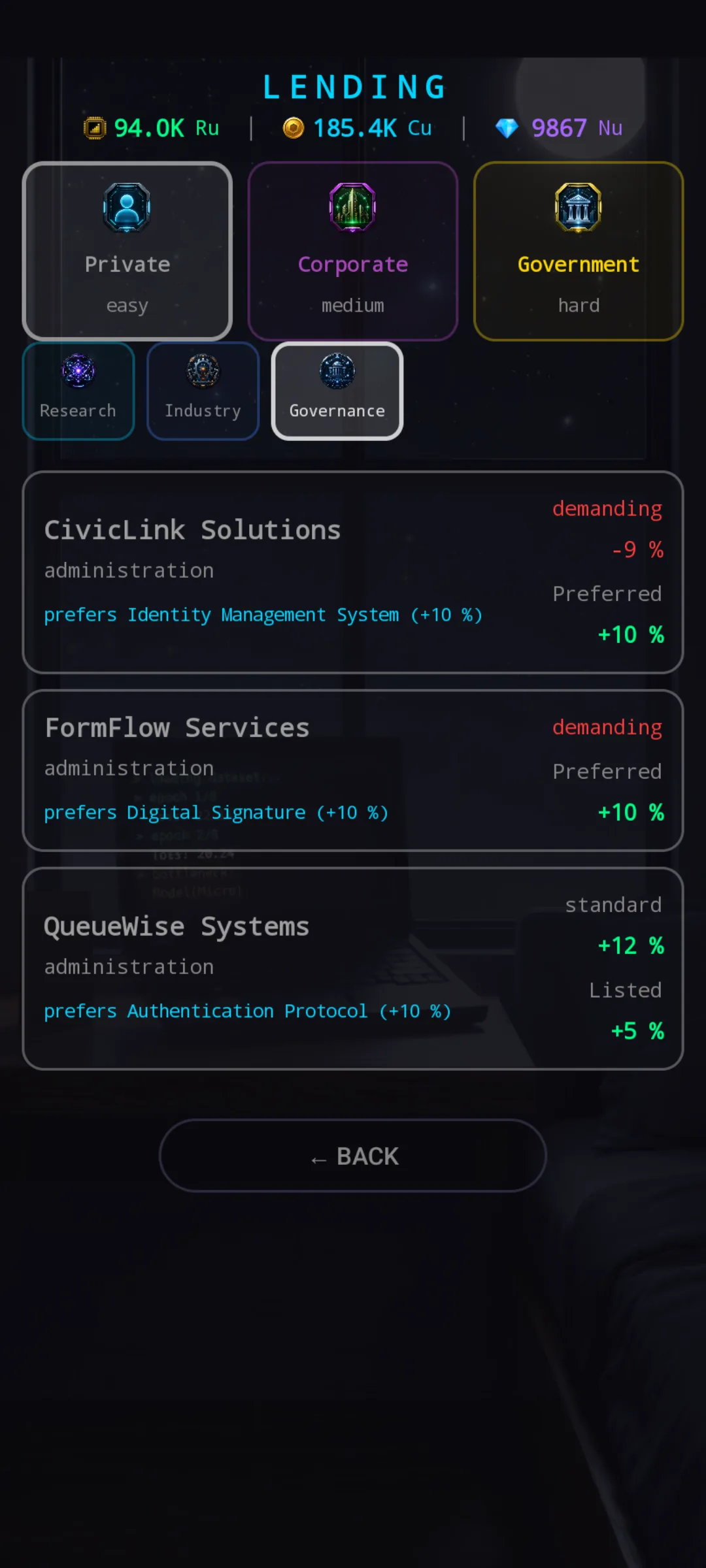
The catalog splits into two axes:
- Class — Private (easy), Corporate (medium), Government (hard). The difficulty in the chip subtitle isn't cosmetic — it drives how fast the model wears down (see §difficulty).
- Sector — Research, Industry, Governance, and so on. Each sector's vendors prefer SW from that sector's corpus, and each vendor within it has its own specific SW preference on top.
Each vendor card carries three signals:
- Difficulty rating (top-right) — demanding, standard, undemanding. This is the vendor's own reputation modifier applied against the class baseline. A "demanding" Private vendor is still Easy, but with a percentage adjustment on the base rate that the card also prints.
- Match tier (below the rating) — Preferred, Listed, or Unproven, with a percentage bonus. This is what the vendor thinks of your model specifically (based on SW loadout — see §preferences).
- Preference line —
prefers <SW name> (+10 %). The specific SW that vendor is asking for this cycle. Not required — an offer, not a filter.
Picking a window
Tap a vendor card and you get a duration modal — 1 h, 4 h, 12 h, or 24 h. For each length, the modal previews:
- Estimated Cu income
- Estimated SW XP that will accrue across installed SW
- Estimated quality loss on the model
- Estimated reputation change
Long windows may be locked (shown red) if your model can't sustain them — that's the game refusing to sell you a bet you can't cover. See §difficulty for what determines "can sustain".
Why the estimate diverges from reality
The estimate extrapolates from the first hour and multiplies. That's a fair approximation for a short loan, but the longer the window, the more the numbers drift — because the vendor's per-hour rate falls as your model's quality falls, and the flat multiplication ignores that.
The real cost — quality & hardware wear
Lending doesn't destroy the model. It drains its quality, which you rebuild with runs. So the real price of a loan is:
- The Cu income you got from the loan, minus
- The time you spend running the model back up to fresh, and
- The hardware wear that those recovery runs cause — repair Cu on the rig.
SW leveling: what deployment builds up over time
Installed SW accrues XP while the model is deployed. The XP is split across all installed SW on that model, so a wider rack levels each individual piece more slowly. Levels do two things:
- The model survives longer. Higher-level SW absorbs more damage per hour — a model with everything at L20 can take a hard contract that would eat a fresh one alive.
- The model is worth more. One SW at L50 doubles the model's price. Three SW at L100 quintuple it. A veteran model with a levelled rack is a much more valuable sale candidate than the same model fresh out of compile.
SW rarity here is a trade, not a ladder. Common baseline SW levels faster but earns a base rate per hour. Rare emergent SW levels slowly but earns a meaningful premium per hour. Refined and distilled sit between the two curves.
The interesting racks are mixed: a levelled baseline holds the survivability line, an emergent alongside brings the money. And because XP splits across the whole rack, you get to decide whether you want one strong piece or three average ones.
Three difficulties, and when to move up
Private is calm, corporate is standard, government is hot. The difference isn't just money — a harder contract wears the model down orders of magnitude faster. Until your SW is around level twenty, hard will chew through your model faster than an hour of clock time.
So the move up doesn't come because the game allows it. It comes when your rack starts absorbing the damage — and you notice, because it starts paying. The unlock signal isn't a difficulty gate; it's the moment the numbers on the duration modal stop looking scary.
Reputation and uncovered hours
Vendor reputation now moves on lending too, not just on contracts. A completed loan window raises it; an incompleted one drops it — and the penalty is measured in uncovered hours, not as a binary miss.
Promise a full day and drop after three hours, and the vendor was without coverage for twenty-one, and they know that. Promise the same day and cover twenty-two of the twenty-four, and the penalty is a fraction of that.
Higher reputation means higher rent — up to a quarter more. Contracts remain the primary track — a sold model stays with the vendor, a lent one you only had them for a while — but lending is now a real second income stream, and the vendors remember which operators kept their word.
Vendor preferences — the loot chain gets a target
Vendors pay a premium for SW that matches their sector, and an additional premium for the specific SW they've listed as their preference right now:
- Sector-corpus match — SW from the corpus the vendor's sector uses (Security-sector vendors care about Security-corpus SW, and so on). This is a passive bonus; every eligible vendor of that sector pays a bit extra for it.
- Specific SW preference — the
prefers <SW name> (+10 %)line on the vendor card. Bringing the specific SW they asked for stacks on top of the sector-corpus bonus. - Match tier badge — combines the two signals into Preferred, Listed, or Unproven, with the percentage printed next to the badge.
Nothing here is required — every vendor still takes any model with a compiled SW. But this is the first time the SW loot chain has a target attached: I want this SW, and I know who'll pay for it.
Watching an active loan
While a loan is running, a green status bar sits at the top of the Lending screen with the model name, vendor name, difficulty, elapsed vs. remaining time, and a +X Cu recall figure. Recall is what you would get by pulling the model out early — the loan settles at that number, quality still drains through the moment of recall, and reputation applies the uncovered-hours penalty for whatever time was left.
Recall is not a soft-cancel. It's a legitimate exit if conditions change — a contract lands that needs the model, you notice quality dropping faster than the estimate hinted, the vendor's rate looked better in retrospect than it does now. It costs reputation, and that reputation loss is visible before you tap.
Quick tips
- Match the rig before you lend hard. Repair cost scales with rig tier. A weak model on a top-end rig is a Cu leak dressed as an income stream.
- Discount the estimate on long windows. The 24 h projection is the least accurate. Do a couple of 1 h loans on the same model first to see the shape.
- Don't over-promise. Uncovered hours are the reputation penalty. Small delivered loans beat big broken ones for standing.
- Read the preference line on every card.
The
prefers X (+10 %)line stacks with your SW loadout; picking the vendor whose preference matches what you already have is often the whole game. - SW rarity is a trade, not a ladder. Baseline levels fastest, emergent pays best per hour. Mixed racks are usually the strongest builds.
- Government is not the goal. It's the tier you unlock naturally when your rack survives it. Don't force it — the wear will eat you.